
Of Course or Ofcourse: Correct Spelling, Meaning, Grammar, and Examples
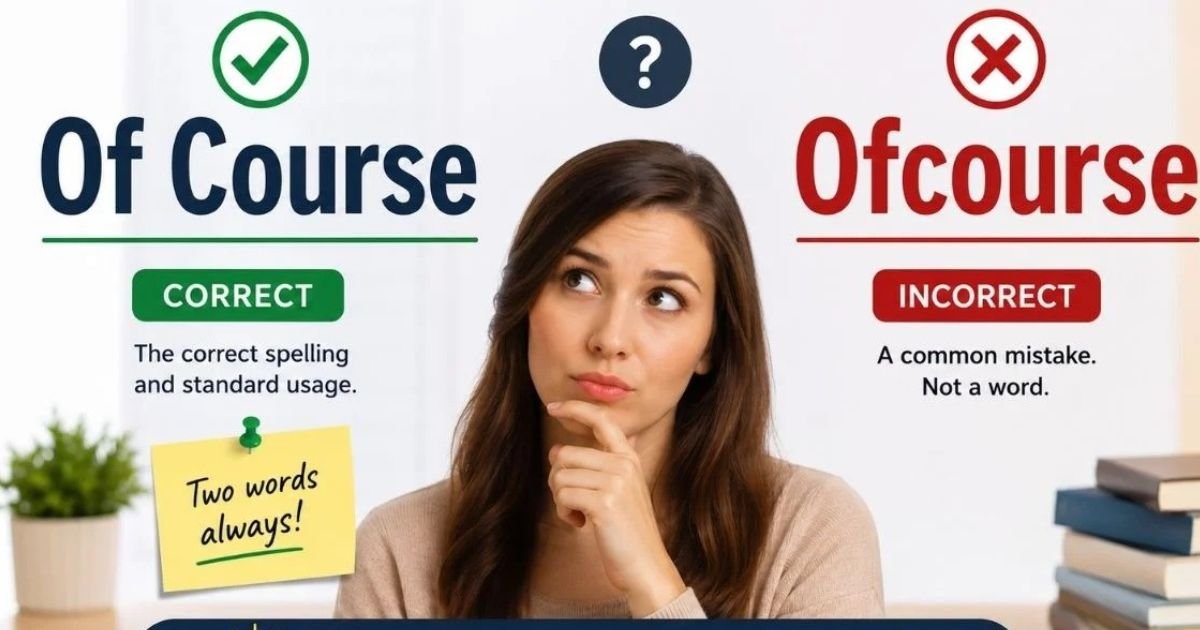
Have you ever wondered whether to write “of course” or “ofcourse”? These two forms may look similar, but only one is correct in standard English. The confusion often occurs because people pronounce the phrase quickly, making it sound like a single word. However, the correct spelling always contains two separate words: of course.
If you are writing a school assignment, preparing a professional email, sending a text message, or creating content for a website, knowing the correct spelling helps you communicate clearly and confidently. Although “ofcourse” appears frequently in online conversations, social media posts, and informal messages, it is not the standard spelling of this expression.
In this guide, you will learn the difference between of course and ofcourse, the meaning of the phrase, its grammatical function, correct punctuation, common mistakes, and practical examples. You will also discover how to use related expressions such as “yes, of course,” “of course not,” and “off course” correctly.
Of Course or Ofcourse: Which Is Correct?
“Of course” is the correct spelling. “Ofcourse” is incorrect in standard English. The phrase must be written as two separate words, with a space between “of” and “course.”
The expression is commonly used to show agreement, certainty, willingness, or something that is expected or understood. Its meaning depends on the context in which it appears.
Consider these examples:
- Correct: Of course, I can help you with your homework.
- Incorrect: Ofcourse, I can help you with your homework.
- Correct: You can borrow my book, of course.
- Incorrect: You can borrow my book, ofcourse.
The difference is simple. The correct form contains two words, while the incorrect form joins them together.
This rule applies to American English, British English, Indian English, and other varieties of standard English. There is no regional spelling rule that makes “ofcourse” the correct form of this expression.
If you are unsure which version to use, remember that the correct spelling is always “of course,” not “ofcourse.”
Quick Comparison: Of Course vs Ofcourse
The following table explains the difference at a glance.
| Feature | Of course | Ofcourse |
| Correct spelling | Yes | No |
| Number of words | Two | One |
| Accepted in standard English | Yes | No |
| Meaning | Certainly, naturally, or as expected | No standard meaning as this expression |
| Suitable for formal writing | Yes | No |
| Suitable for academic assignments | Yes | No |
| Commonly seen online | Yes | Yes, as a misspelling |
| Correct in professional emails | Yes | No |
The table shows why the two forms should not be treated as interchangeable. Although readers can often understand “ofcourse” when they encounter it, understanding a spelling mistake does not make that spelling correct.
For reliable writing, use “of course” in every sentence where you want to express certainty, agreement, or willingness.
What Does Of Course Mean?
The phrase “of course” has several related meanings. It can communicate that something is certain, expected, obvious, or acceptable. It can also serve as a polite and positive response to a request.
The exact meaning depends on the conversation, the speaker’s intention, and the tone of the sentence.
1. Of Course Means Certainly
One of the most common meanings of “of course” is “certainly” or “definitely.”
People use it to confirm that something will happen or that they agree to do something.
Examples:
- Of course, I will attend your birthday party.
- She will, of course, complete the assignment on time.
- Of course, we can discuss the project tomorrow.
- I will of course send you the details later.
In these sentences, the phrase communicates confidence or certainty. It makes the statement sound natural and conversational.
2. Of Course Means Yes
The phrase can also function as a positive answer to a question or request.
For example:
Person A: Can you help me with this task?
Person B: Of course!
Here, “of course” means “yes, certainly.” It communicates willingness to help.
Additional examples include:
- “May I sit here?” “Of course.”
- “Can I call you this evening?” “Of course.”
- “Would you mind explaining this rule?” “Of course, I’d be happy to.”
- “Can we work together on this project?” “Of course!”
This use is particularly common in everyday conversations because it sounds friendly and reassuring.
3. Of Course Means Naturally
Sometimes, “of course” indicates that something is natural, expected, or reasonable.
Examples:
- Of course, children need time to learn new skills.
- Of course, regular practice improves your English.
- She was tired after working all day, of course.
- Of course, good communication takes effort.
In these examples, the expression suggests that the information makes sense given the situation.
4. Of Course Means Obviously
The phrase can also introduce information that the speaker believes is already known or easily understood.
Examples:
- Of course, the sun rises in the east.
- Of course, you should save your work before closing the computer.
- He knew, of course, that preparation was important.
- Of course, a broken phone may need professional repair.
However, be careful when using this meaning in conversation. If you tell someone “of course” in response to a question, they might interpret it as impatience or believe you think their question was unnecessary.
Your tone and the relationship between the speakers can influence how the phrase is understood.
Why Is Of Course Written as Two Words?
The expression consists of two separate words, “of” and “course.” Together, they form an established English phrase that functions adverbially in many sentences.
The word “of” is a preposition, while “course” is a noun. When used together in this familiar expression, they communicate an idea such as certainty, natural expectation, or agreement.
English contains many expressions made from multiple words that function together as a single unit of meaning. These expressions do not automatically become one word simply because people frequently use them.
For example:
- Of course
- In fact
- At least
- As well
- In general
- For example
- By the way
Each expression contains separate words, even though the words work together to communicate a particular idea.
Similarly, “of course” retains its two-word spelling regardless of how frequently it appears in conversation.
Writing “ofcourse” removes the required space and creates a spelling error. There is no need to add a hyphen or use any other special punctuation between the words.
The correct form is simply of course.
Is Ofcourse a Real Word in English?
No. “Ofcourse” is not the standard English spelling of the expression meaning certainly, naturally, or yes.
You may encounter it in social media comments, online discussions, text messages, captions, and informal conversations. It appears because people sometimes combine words that sound connected when spoken.
However, its frequent appearance online does not make it an accepted spelling.
For example:
Incorrect: Ofcourse I remember your birthday.
Correct: Of course I remember your birthday.
Incorrect: I will ofcourse help you.
Correct: I will, of course, help you.
Incorrect: Ofcourse you can join us.
Correct: Of course you can join us.
Notice that the correction does not change the meaning of any sentence. It simply restores the correct spelling.
There is one important distinction: a particular username, company name, brand, or website could deliberately use “Ofcourse” as a proper name. That special use does not make it the correct spelling of the ordinary English phrase.
When you are writing normal English prose, use “of course.”
Of Course in American, British, and Indian English
English has several regional varieties, including American English, British English, and Indian English. Some words have different accepted spellings depending on the variety being used.
For example, American English generally uses “color,” while British and Indian English commonly use “colour.”
However, the spelling of “of course” does not change in these varieties.
American English
In the United States, “of course” is the standard form.
Examples:
- Of course, I can help you with the presentation.
- You can contact our office, of course.
- Of course not! I did not forget your birthday.
British English
In the United Kingdom, the expression is also written as two words.
Examples:
- Of course, you may borrow my notebook.
- She will, of course, be joining us later.
- Of course, we can arrange another meeting.
Indian English
In India, standard written English follows the same spelling rule.
Examples:
- Of course, I will complete the assignment today.
- Of course, you can ask your teacher for clarification.
- We can discuss the matter tomorrow, of course.
Therefore, whether you are writing for an American audience, a British reader, or an Indian audience, the correct spelling remains the same.
There is no difference between American, British, and Indian English in this particular spelling rule.
How to Use Of Course in a Sentence
Understanding the meaning of a phrase is useful, but knowing how to place it naturally within a sentence is equally important.
“Of course” can appear at the beginning, in the middle, or at the end of a sentence. Its placement depends on the structure and emphasis of the statement.
1. Of Course at the Beginning of a Sentence
When the phrase appears at the beginning, it often introduces an agreement, explanation, or statement that the speaker considers expected.
Examples:
- Of course, I will help you prepare for the examination.
- Of course, you can use my laptop for your presentation.
- Of course, learning a language takes patience.
- Of course, we should check the details before making a decision.
- Of course, she is welcome to attend the meeting.
A comma is commonly used after the introductory phrase, particularly when it is followed by a complete statement.
2. Of Course in the Middle of a Sentence
The phrase can also appear in the middle of a sentence, where it adds emphasis or presents information as expected.
Examples:
- We can, of course, discuss the details tomorrow.
- She is, of course, welcome to join our team.
- The final decision will, of course, depend on the available information.
- You should, of course, read the instructions carefully.
- He was, of course, delighted by the news.
When “of course” interrupts the main sentence, commas can be used on both sides to separate it from the surrounding statement.
However, punctuation depends on the sentence structure. Not every use of “of course” requires two commas.
3. Of Course at the End of a Sentence
The expression can appear at the end when the speaker wants to add a final confirmation or reminder.
Examples:
- You can join us, of course.
- I will help you with the project, of course.
- We can change the meeting time, of course.
- She knows how important the deadline is, of course.
- You are welcome to contact me again, of course.
A comma before the phrase is often appropriate when it functions as an additional comment.
4. Of Course as a Short Reply
In conversations, the expression can stand alone as a complete response.
Examples:
Question: Can I borrow your pen?
Answer: Of course!
Question: Would you like me to explain the instructions?
Answer: Of course, thank you.
Question: Can we meet tomorrow?
Answer: Of course. What time works for you?
This form is especially useful in everyday speaking and informal writing.
Of Course vs Ofcourse: Common Mistakes and Corrections
Many spelling mistakes occur because people type quickly or assume that a frequently spoken expression should be written as one word.
Here are common mistakes and their correct versions.
| Incorrect sentence | Correct sentence |
| Ofcourse, I will come. | Of course, I will come. |
| I can ofcourse help you. | I can, of course, help you. |
| Yes, ofcourse! | Yes, of course! |
| Ofcourse she knows the answer. | Of course she knows the answer. |
| You are ofcourse welcome. | You are, of course, welcome. |
| Ofcourse not. | Of course not. |
| Thanks, ofcourse I will join. | Thanks. Of course, I will join. |
| Ofcourse we can try again. | Of course we can try again. |
The most important correction is consistent across all these examples: separate “of” and “course.”
You should also pay attention to punctuation. The phrase itself remains unchanged, but commas and full stops may vary according to its position and function.
A useful editing habit is to search your writing for “ofcourse” before publishing an article, submitting an assignment, or sending a professional email.
Of Course vs Off Course: What Is the Difference?
Another common source of confusion is the difference between “of course” and “off course.”
Although the expressions sound similar, they have different spellings and meanings.
Of course means certainly, naturally, or as expected.
Off course means that something has moved away from its intended route, direction, plan, or target.
Consider the following examples:
- Of course, I will attend the meeting.
- The aircraft went off course because of severe weather.
- Of course, we should review the plan.
- The boat drifted off course during the storm.
- Of course, I understand your concern.
- Our project has gone off course because of unexpected delays.
In the first, third, and fifth sentences, “of course” expresses certainty or agreement.
In the second and fourth sentences, “off course” describes a change in direction. In the final sentence, it is used figuratively to describe a project that has moved away from its intended plan.
Remember these simple distinctions:
- Of course: certainly or naturally.
- Off course: away from the intended path.
- Ofcourse: incorrect as the standard spelling of the expression.
This distinction is particularly important because “of course” and “off course” are both valid expressions, but they cannot be substituted for one another.
Of Course vs Of Cause: Which One Is Correct?
Another spelling confusion involves “of cause.”
When someone wants to express agreement or certainty, the correct expression is “of course,” not “of cause.”
The word “cause” refers to a reason or something that produces an effect. It is not a replacement for “course” in this expression.
Examples:
Incorrect: Of cause, I will help you.
Correct: Of course, I will help you.
Incorrect: Of cause she was happy to see her family.
Correct: Of course she was happy to see her family.
However, the words “of” and “cause” can appear separately in a sentence where the context genuinely refers to a cause or reason.
For example:
- The importance of cause and effect is discussed in the lesson.
- The report explains the role of cause in the resulting problem.
These are different grammatical constructions. If your intended meaning is “certainly,” “yes,” or “naturally,” always write “of course.”
Of Course vs Sure, Certainly, and Absolutely
Several expressions have meanings similar to “of course,” but they are not always interchangeable.
Understanding their differences helps you choose the most suitable wording for a particular situation.
Of Course
This expression communicates agreement, certainty, or willingness. Depending on the context, it can sound friendly, confident, or slightly impatient.
Example: Of course, I can help you prepare for the interview.
Sure
“Sure” is a common and casual way to agree to a request.
Example: Sure, I can send you the document.
It is especially common in everyday conversations and short messages.
Certainly
“Certainly” expresses agreement or confidence and can sound more formal or professional.
Example: Certainly, I will review the report before the meeting.
It is useful in customer service, workplace communication, and formal responses.
Absolutely
“Absolutely” communicates strong agreement or enthusiastic confirmation.
Example: Absolutely! Your idea sounds excellent.
It is often appropriate when you want to emphasize enthusiasm or strong support.
Naturally
“Naturally” suggests that something is expected or follows logically from a situation.
Example: Naturally, everyone wants to do their best.
It is more appropriate when discussing what would reasonably be expected than when simply granting permission.
The best expression depends on your intended meaning, audience, and tone. All these expressions can be correct, but “of course” remains the appropriate choice when you want to communicate certainty or willingness using that particular phrase.
How to Remember the Correct Spelling of Of Course
If you frequently confuse “of course” with “ofcourse,” a simple memory technique can help.
1. Remember the Two-Word Rule
Think of the expression as two separate parts:
OF + COURSE = OF COURSE
There is always a space between the words.
2. Read It Slowly
When you are uncertain, pronounce the phrase slowly and visualize the two written words.
Although natural speech may blend the sounds together, the written form remains separate.
3. Use It in Practice Sentences
Write a few sentences containing the expression.
For example:
- Of course, I will help.
- Of course, you are welcome.
- Yes, of course.
- Of course not.
- I understand, of course.
Repeated practice helps reinforce the correct spelling.
4. Check Your Writing Before Sending It
Before submitting an assignment or sending an important message, search for “ofcourse” and replace it with “of course” wherever you intended to use the expression.
Spell-checking tools can also help, although you should not rely entirely on automatic corrections.
5. Remember That Familiarity Does Not Equal Correctness
You may see “ofcourse” hundreds of times online. Nevertheless, repeated exposure does not change the standard spelling.
The safest approach is to learn the correct form once and use it consistently.
Can You Use Of Course in Formal Writing?
Yes. “Of course” is acceptable in both formal and informal English. However, its suitability depends on the context and the meaning you want to communicate.
In a professional email, it can express willingness to help or confirm that a request is acceptable.
Example:
“Of course, I will send the revised document before the deadline.”
In an academic essay, it can introduce a point that the writer considers established or expected.
Example:
“Of course, the results should be interpreted in light of the study’s limitations.”
In a formal report, it may appear within a sentence as an additional comment.
Example:
“The findings will, of course, require further evaluation.”
Nevertheless, avoid using the phrase repeatedly in every paragraph. Overuse can make your writing sound repetitive or conversational when a more precise expression would be better.
Depending on the context, you might use “certainly,” “naturally,” “as expected,” or “it is important to note” instead.
Most importantly, never use “ofcourse” in place of the standard two-word spelling when preparing academic work, job applications, professional documents, website articles, or business correspondence.
Is Of Course Appropriate in Text Messages and Social Media?
Yes. “Of course” is perfectly acceptable in text messages, online chats, captions, comments, and social media posts.
For example:
- Of course! See you soon.
- Of course, I remember you.
- Yes, of course you can join us.
- Of course, that makes sense.
- Of course not! Don’t worry.
You do not need a different spelling simply because the conversation is informal.
In casual digital communication, some people use “ofc” as an abbreviation for “of course.” This abbreviation is common in informal messaging, but it is not the same as writing “ofcourse” as one word.
For example:
- Full expression: Of course, I can help.
- Informal abbreviation: Ofc, I can help.
The full expression is preferable when clarity and standard written English matter. In professional messages, formal writing, or situations where your reader might not understand internet abbreviations, write “of course” in full.
What Does Yes, Of Course Mean?
“Yes, of course” is a positive expression that combines direct agreement with an indication of certainty or willingness.
It generally means “yes, certainly,” “yes, absolutely,” or “yes, you are welcome to do that.”
For example:
Question: Can I ask you a question?
Answer: Yes, of course.
The response indicates that the speaker is willing to listen.
Another example:
Question: Would you be able to help me with this assignment?
Answer: Yes, of course. Let’s look at it together.
Here, the phrase communicates agreement and reassurance.
However, the expression can occasionally sound dismissive if the listener believes the answer should have been obvious. To avoid this impression, use a warm tone and add a friendly explanation when appropriate.
For example, instead of responding with only “Of course,” you could say, “Of course, I’d be happy to help.”
This makes your intention clearer and can make the interaction feel more welcoming.
Read more: Peter Orszag Bald: Is He Bald, and What Is Known About His Hair?
What Does Of Course Not Mean?
“Of course not” is the negative form of the expression. It is used to reject an assumption, deny something, or reassure someone that an unwanted situation is not true.
Examples:
- Of course not! I would never do that.
- Of course not, you have nothing to worry about.
- Of course not. You can ask me whenever you need help.
- “Are you angry with me?” “Of course not.”
- “Did you forget the meeting?” “Of course not. I have it on my calendar.”
The exact tone depends on the context. “Of course not” may sound reassuring, emphatic, or occasionally impatient.
The spelling does not change in the negative form. You must still write “of course” as two separate words.
Incorrect: Ofcoursenot.
Correct: Of course not.
Incorrect: Ofcourse not!
Correct: Of course not!
Of Course Grammar: What Part of Speech Is It?
In common English usage, “of course” functions as an adverbial expression. It modifies a statement by communicating certainty, expectedness, agreement, or the speaker’s attitude toward the information.
Unlike a typical single-word adverb, it consists of two words that work together to express a particular meaning.
Consider these examples:
- Of course, she understands the instructions.
- We can, of course, review the results again.
- The answer is correct, of course.
- Of course, regular exercise can support general well-being.
In the first sentence, the phrase introduces the statement and communicates that the information is expected or accepted.
In the second sentence, it adds a comment to the main statement.
In the third sentence, it reinforces the speaker’s assessment.
In the fourth sentence, it introduces information presented as a reasonable observation.
The expression does not usually change its form according to tense, number, or the subject of the sentence.
For example, you can write:
- Of course, I agree.
- Of course, she agrees.
- Of course, they agreed.
- Of course, we will agree.
The verb changes according to the sentence, but “of course” remains the same.
Is There a Hyphen in Of Course?
No. The standard expression is written as two words without a hyphen.
Correct: Of course, I understand.
Incorrect: Of-course, I understand.
Incorrect: Ofcourse, I understand.
Do not insert a hyphen between “of” and “course” when using the expression to mean certainly or naturally.
This rule applies whether the phrase appears at the beginning, middle, or end of a sentence.
For example:
- Of course, you can participate.
- You can, of course, participate.
- You can participate, of course.
All three sentences use the same spelling. Only the position of the expression and the punctuation change.
Of Course Examples for Everyday Situations
The following examples demonstrate how to use the correct spelling in different contexts.
Everyday Conversation
- Of course, I will call you later.
- Of course, you can sit beside me.
- Of course, we can go shopping together.
- Of course, I remember that day.
- Of course, you may ask another question.
Education and School
- Of course, students should revise their lessons regularly.
- Of course, I will complete my homework tonight.
- Of course, the teacher can explain the difficult topic again.
- Of course, reading improves vocabulary.
- Of course, practice is important when learning grammar.
Workplace Communication
- Of course, I will send the updated report.
- We can, of course, arrange another meeting.
- Of course, I will review the proposal.
- Of course, the team can discuss the available options.
- I will share the information with you, of course.
Friendship and Family
- Of course, I will be there for your birthday.
- Of course, you can tell me what happened.
- Of course, I remember our first meeting.
- Of course, you can stay with us tonight.
- Of course, I am happy to see you.
Online Communication
- Of course! I will reply as soon as possible.
- Of course, you can share the post.
- Of course, I will send you the link.
- Yes, of course, that sounds good.
- Of course not! I have not forgotten.
These examples illustrate that the spelling remains the same across different settings.
Frequently Asked Questions About Of Course or Ofcourse
Is it of course or ofcourse?
“Of course” is correct. It must be written as two separate words. “Ofcourse” is an incorrect spelling when used to express certainty, agreement, or willingness.
Is ofcourse one word or two words?
The standard expression consists of two words: “of course.” Writing it as one word is a spelling mistake.
How do you spell of course correctly?
Spell it as “of course,” with a space between “of” and “course.” Do not join the words or place a hyphen between them.
What is the meaning of of course?
“Of course” generally means certainly, naturally, obviously, or yes. It can express agreement, willingness, confidence, or something that is expected.
Is ofcourse grammatically correct?
No. “Ofcourse” is not the standard spelling of the expression. Use “of course” in formal and informal writing.
Can I write ofcourse in a text message?
You may see people use it in text messages, but it is still considered a spelling error in standard English. The correct form is “of course,” even in casual messages.
Is of course correct in American English?
Yes. American English uses “of course” as two separate words. “Ofcourse” is not the standard form.
Is of course correct in British English?
Yes. British English follows the same spelling rule. The correct expression is “of course.”
Is of course correct in Indian English?
Yes. Standard Indian English also uses “of course.” There is no regional spelling difference in this expression.
Should I write of course or off course?
Use “of course” when you mean certainly, naturally, or yes. Use “off course” when describing something that has moved away from its intended route or direction.
For example, “Of course, I will help you” is correct, while “The boat went off course” describes a change in direction.
Is of cause correct?
Not when you mean certainly or naturally. The correct expression is “of course.” The word “cause” refers to a reason or something that produces an effect.
What does yes, of course mean?
“Yes, of course” is a positive response that communicates agreement, certainty, or willingness. It often means “yes, certainly” or “absolutely.”
Is there a comma after of course?
A comma is commonly used after “of course” when it begins a sentence as an introductory expression.
Example: “Of course, I can help you.”
When it appears in the middle or at the end of a sentence, commas may be used depending on the sentence structure and intended emphasis.
Can of course be used in formal writing?
Yes. It is acceptable in professional emails, academic writing, reports, and other formal documents. However, it should be used thoughtfully to maintain an appropriate tone.
What is the difference between of course and certainly?
Both can communicate agreement or confidence. “Certainly” often sounds more formal, while “of course” can sound conversational, reassuring, or natural. The best choice depends on the context.
What is the short form of of course in texting?
“Ofc” is a common informal abbreviation for “of course.” It is often used in online chats and text messages. In formal writing, use the full expression.
Does of course need a hyphen?
No. Write “of course” as two words without a hyphen.
Why do people write ofcourse?
People often combine the words because they are pronounced closely together in natural speech. Typing quickly, unfamiliarity with the spelling rule, and repeated exposure to online mistakes can also contribute to the confusion.
Final Verdict: Of Course or Ofcourse?
The correct spelling is of course, written as two separate words. “Ofcourse” is a common spelling mistake and should not be used as the standard English expression.
The phrase can mean certainly, naturally, obviously, or yes, depending on the context. It is suitable for everyday conversations, text messages, professional emails, academic assignments, and website content.
Remember these three rules:
- Write “of course” as two separate words.
- Do not write “ofcourse” or “of-course” when using the ordinary expression.
- Do not confuse “of course,” which expresses certainty or agreement, with “off course,” which means away from an intended path or direction.
Once you remember that the phrase always contains a space, choosing the correct spelling becomes easy. Whether you are writing for readers in the United States, the United Kingdom, India, or elsewhere, “of course” is the correct form to use in standard English.