
PLG Supplies: What It Is, Products, Bulk Orders and Buyer Guide
Every business runs on supplies. An office needs paper, ink and chairs. A warehouse needs boxes, tape and labels. A clinic needs gloves, masks and cleaning products. A building site needs pipes, tools and safety gear. When each of these items comes from a different seller, ordering turns into a weekly chore of phone calls, invoices and delivery dates that never line up.
PLG Supplies presents itself as an answer to that problem. The company describes itself as a wholesale, business to business supplier that brings many everyday work products under one roof. Offices, factories, schools, hospitals, warehouses and building companies are all named in its company descriptions as the kinds of customers it aims to serve. The idea is simple: one supplier, one order, one delivery schedule, instead of a dozen small orders scattered across different sellers.
But a big product list on its own does not make a supplier a good choice. Price, quality, delivery and trust all matter, and a business that buys in bulk has more at stake than a shopper buying a single item. A bad batch of gloves, a late delivery of packing boxes or a plumbing part that does not fit can slow down real work and cost real money.
This guide looks at PLG Supplies in full: what the company says it is, the four product groups it lists, who uses it, how bulk ordering works, what delivery it claims, and, most importantly, what a buyer should check before placing an order. Everything about the company in this article is presented as the company’s own claim, because its legal registration and business details have not been independently confirmed. A dated buyer check note from November 2026 runs through the whole guide, so you can use this article as a practical checklist rather than a sales pitch.
What Is PLG Supplies?
PLG Supplies is the name used by a business that sells work supplies to other businesses. Its stated range covers industrial tools, office goods, packing and shipping materials, plumbing and gas equipment, and medical and safety products. The company follows a business to business model, often written as B2B. That means it sells to companies, schools, clinics and other organisations rather than to ordinary home shoppers.
The company name appears in its own materials as PLG Supplies Ltd. It describes itself as a United States based wholesale distributor. Its stated goal is to make business buying easier by offering many types of supplies in one place, so a customer does not have to chase several sellers for everyday items.
Some web sources expand the letters PLG as “Procurement, Logistics, and General Supplies”. That expansion is commonly used online, but it is not a confirmed legal fact about the company, so treat it as a popular explanation of the name rather than an official one. The company itself is presented in its own descriptions simply as a wholesale supplier of general business products.
PLG Supplies and Product-Led Growth: Not the Same Thing
The letters PLG can cause confusion, because in the software world PLG usually stands for Product-Led Growth. That is a business strategy where a software product sells itself through free trials and user experience, and it has nothing to do with boxes, pipes or gloves. If you search for PLG online you will see plenty of software articles, and those are about a different idea entirely.
This article is only about PLG Supplies, the supplies company. When you research it, add the word “supplies” to every search, and be careful not to mix it up with other companies that share the same initials. For example, Pacific Logistics Group is a logistics firm based in Singapore, and PLG sp. z o.o. is a separate company in Poland that deals in medical instruments. Both are different companies, and their facts, history and services do not belong to PLG Supplies.
What We Know, and What We Do Not Know
Here is an honest starting point. PLG Supplies Ltd. describes itself as a United States based wholesale distributor, and its product descriptions are detailed enough to discuss in this guide. What has not been independently confirmed is its legal registration, its company history and its ownership. Some online profiles claim the company was founded in 2008, but that date could not be confirmed, so this guide does not state it as a fact.
That gap matters. A real supplier should be easy to check: a registered business address, a working phone number, a verifiable website, customer reviews from real buyers and clear terms for payment, returns and delivery. Until a buyer has checked those things, every claim in this guide should be read as “the company says”, not as a proven fact. The buyer verification checklist near the end of this article walks through exactly how to do those checks before you spend money.
PLG Supplies at a Glance
Before going into detail, here is a short summary of what the company claims to offer. Use it as a quick reference, then read the sections below for the full picture and the checks that go with each claim.
| Detail | What the company claims | What to check before ordering |
|---|---|---|
| Business type | Wholesale B2B distributor | Confirm it sells to businesses and accepts business payment terms |
| Location | United States based | Ask for the registered business address and check it against official records |
| Product groups | Four: industrial and office, packaging and shipping, plumbing and gas, medical and safety | Ask for the current catalogue and confirm stock for the items you need |
| Bulk orders | Wholesale pricing and large orders | Get a written quote with minimums, unit price and delivery cost |
| Custom sourcing | Can find products outside the regular range | Agree on specifications, lead time and price in writing first |
| Delivery | Shipping across all 50 U.S. states, with standard, fast and freight options | Confirm cost, delivery time and tracking before you pay |
| Customers | Factories, hospitals, schools, offices, warehouses and building companies | Ask for references or reviews from similar businesses |
The Four Product Groups of PLG Supplies
PLG Supplies organises its range into four main groups. Each group serves a different kind of workplace, but the groups overlap in useful ways. A warehouse, for example, may need items from three groups at once: packing materials, safety gloves and cleaning products. A hospital may need medical items, office goods and cleaning supplies in the same order. That overlap is the heart of the company’s pitch: one order can cover several departments.
The table below gives an overview of all four groups. The sections that follow take each group in turn, with examples of what it includes, who uses it and what to check when buying from it.
| Product group | Typical items | Main users | Key buying check |
|---|---|---|---|
| Industrial and office supplies | Hand tools, power tools, machine parts, desks, chairs, paper, ink, cleaning products | Factories, repair shops, offices, schools | Size, quality, brand and warranty for tools and furniture |
| Packaging and shipping materials | Boxes, bubble wrap, packing tape, stretch film, labels, straps, pallet covers | Warehouses, online stores, fulfilment centres | Box strength, dimensions and material grade |
| Plumbing and gas equipment | Pipes, valves, fittings, faucets, water meters, gas hoses, regulators | Building companies, plumbers, maintenance teams | Exact size, pressure rating and safety approval |
| Medical and safety products | Gloves, masks, gowns, face shields, first-aid kits, thermometers, sanitisers | Hospitals, clinics, schools, workplaces | Certifications, expiry dates and correct protection level |
Industrial and Office Supplies
The first product group covers two worlds that often sit side by side in the same business: the workshop and the office. Industrial supplies keep machines running and repairs moving, while office supplies keep desks, meetings and paperwork working. A company that buys both from one supplier can plan its monthly restock in a single order instead of two.
Industrial Tools and Equipment
PLG Supplies lists hand tools, power tools, machine parts and safety gear among its industrial products. These are the items factories, repair shops and maintenance teams reach for every day. Hand tools cover the basics, from wrenches and screwdrivers to cutting and measuring tools. Power tools cover drilling, cutting and fastening work. Machine parts cover the spares that keep equipment running when something wears out.
Quality matters more here than in almost any other group. A cheap tool that breaks during a job can damage a machine or hurt a worker. A machine part that is slightly the wrong size can stop a production line. Before ordering tools or parts in bulk, ask for the brand, the material, the specifications and the warranty terms. If the supplier cannot name the brand or provide a specification sheet, that is a warning sign, and a small test order is safer than a large one.
Storage and handling matter too. Tools and parts should arrive packed so they do not get damaged in transit, and items should be labelled clearly so the right part reaches the right machine. When you place a first order, check the packing and labelling as carefully as the products themselves.
Office Furniture and Everyday Office Goods
On the office side, the company lists desks, chairs, printer paper, ink, files and cleaning products. These are the items that run out quietly and cause loud problems: an office that runs out of printer paper before an important meeting, or a team that cannot print a report because the ink is finished, loses time it cannot get back.
Office furniture deserves a closer look than paper and ink. A desk or chair is used for hours every day, so comfort, build quality and size matter. Ask for dimensions, weight limits and assembly details before ordering furniture in bulk. For paper and ink, check compatibility with your printers, because the wrong cartridge or the wrong paper weight can cause jams and waste.
Cleaning products round out this group. Offices, schools and clinics all need regular cleaning supplies, and buying them alongside office goods in one order can simplify stock checks. Check the ingredients and safety labels, especially if cleaning products will be used in schools, clinics or food areas, and store them according to the label instructions.
Who Buys Industrial and Office Supplies?
- Factories that need tools, spares and safety gear for daily production and maintenance.
- Repair shops that use hand and power tools and keep a stock of common parts.
- Offices that need paper, ink, files, furniture and cleaning products every month.
- Schools that need office goods, cleaning products and basic maintenance tools.
- Maintenance teams that look after buildings, machines and shared workspaces.
Packaging and Shipping Materials
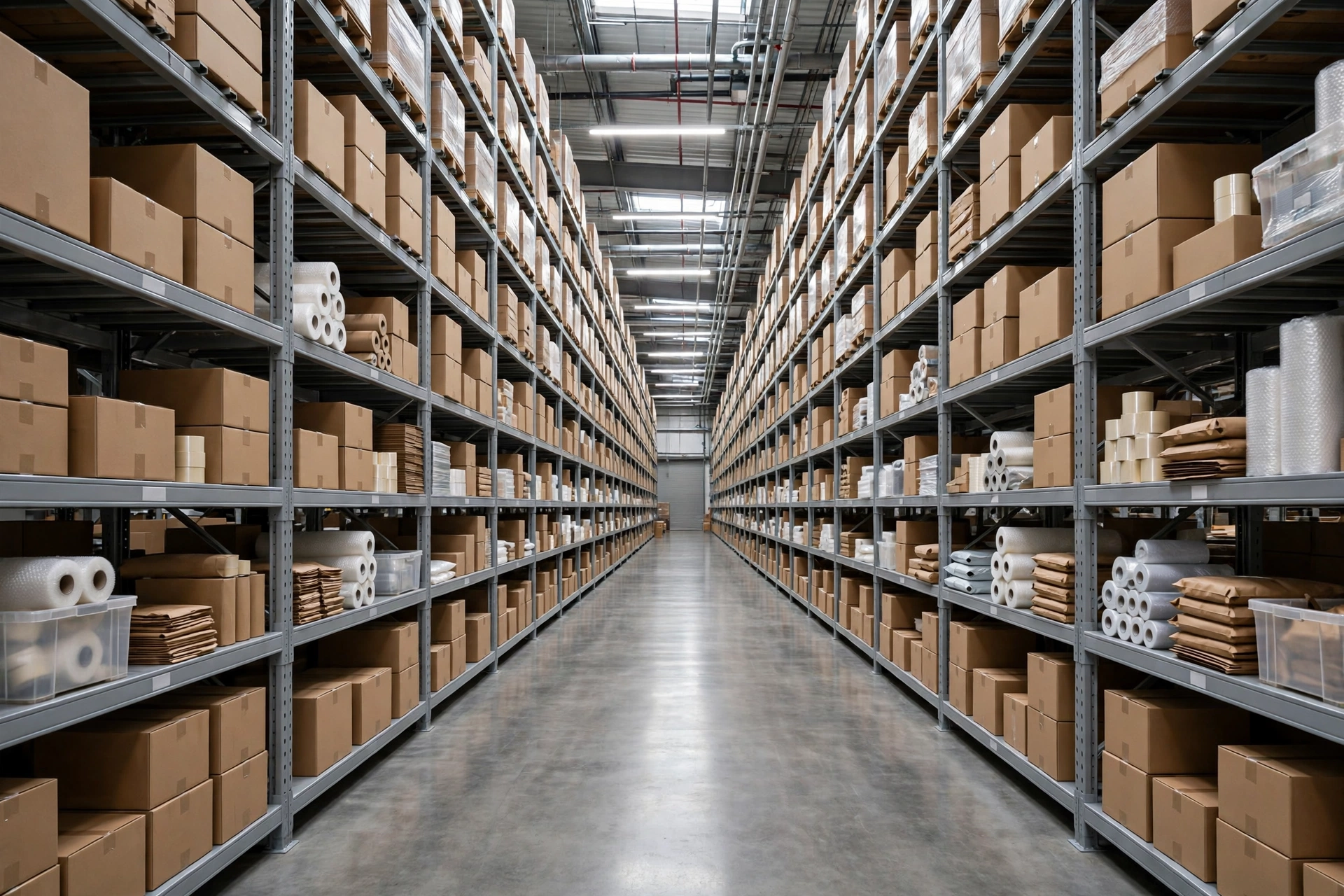
Packaging protects goods while they are stored, moved and delivered. PLG Supplies lists boxes, bubble wrap, packing tape, stretch film, shipping labels and related materials. These items are used by online stores, warehouses and any company that sends goods to customers. Good packaging lowers the risk of damage, and it also makes packing and sorting faster.
A small online shop may need boxes and bubble wrap to protect glass or fragile items. A large warehouse may need strong straps, pallet covers and heavy duty boxes for pallets that travel by freight. Each business needs packaging that matches its own products, so one size never fits all.
| Packaging item | What it is used for | What to check |
|---|---|---|
| Cardboard boxes | Packing and shipping products of all sizes | Box dimensions, wall strength and weight limit |
| Bubble wrap | Protecting fragile items inside a box | Bubble size, roll length and thickness |
| Packing tape | Sealing boxes for storage and shipping | Adhesive strength, width and how it handles cold or heat |
| Stretch film | Wrapping pallets to keep loads steady | Film thickness, stretch and roll size |
| Shipping labels | Addressing and tracking parcels | Label size, printer compatibility and adhesive quality |
| Straps and pallet covers | Securing heavy loads for freight | Load rating, material and weather resistance |
Before buying packaging in bulk, check three things: the exact size, the strength of the material and the amount you actually use in a month. A box that is slightly too small is useless, and a box that is far too big wastes filler, tape and shipping money. A good habit is to count your monthly use of each size and material before placing a bulk order, then order to that number with a small safety margin. Packaging that sits in storage for a year ties up money and floor space, so buying smart matters as much as buying cheap.
Branded packaging is another point worth asking about. Some suppliers offer printed boxes or custom labels, and the reference material suggests PLG Supplies offers custom sourcing, which may include items outside its regular range. If your business wants its name or logo on its packaging, ask whether that is possible, what the minimum order is, what it costs and how long it takes. Get the answer in writing, because custom work is harder to return than a standard box.
Plumbing and Gas Equipment
Plumbing products move water through homes, offices and other buildings, and PLG Supplies lists pipes, valves, fittings, faucets and water meters in this group. These parts are used for new building work, repairs and regular upkeep. A maintenance team that looks after a school or an office block may need a steady supply of common fittings, while a building company needs larger quantities for new projects.
The company also lists gas hoses, regulators and connection parts. These items need extra care, because the wrong part can be unsafe. Gas work should always be handled by trained workers, and parts should only be bought when their size, pressure rating and intended use are confirmed. A part that looks similar to the right one may not fit, and a fitting that is rated for water may not be safe for gas.
Before ordering any plumbing or gas item, check the exact size, the material, the pressure rating and the safety approval that applies to it. Ask for the product specification sheet and keep it with your records. If you are replacing an existing part, take the old part’s details with you, including its size and markings, so the replacement matches. For gas items, confirm that the part meets the rules in your area and that a qualified worker will install it.
Common Plumbing and Gas Items at a Glance
- Pipes in different sizes and materials for water supply and drainage.
- Valves that control the flow of water through a system.
- Fittings and connectors that join pipes and fix leaks.
- Faucets and taps for kitchens, washrooms and work areas.
- Water meters that measure how much water a building uses.
- Gas hoses, regulators and connection parts for gas appliances and systems.
Plumbing and gas orders are a good test of a supplier’s knowledge. A good supplier can help you match a part to a job, confirm the right size and warn you when a cheaper part is not suitable. If a supplier cannot answer basic questions about a fitting’s size or rating, order elsewhere, because the cost of a wrong part in this group is higher than the saving on its price.
Medical and Safety Products
Medical and safety products protect people at work, and this group covers some of the most sensitive items in the whole catalogue. PLG Supplies lists masks, gloves, gowns, face shields and first-aid kits, along with hand cleaners, alcohol wipes and thermometers. These items are used in hospitals, clinics, schools and workplaces where health and safety matter every day.
A clinic needs fresh gloves and clean tools for every patient. A school needs first-aid kits, cleaning products and protective items for its staff and students. A factory needs gloves, eye protection and safety gear for workers who handle machines or chemicals. Running out of any of these items is not just an inconvenience, it can stop work or put people at risk.
Not all safety products offer the same protection, and this is where careful buying matters most. A glove made for light cleaning work is not the same as a glove made for medical use. A mask made for dust is not the same as a mask made for clinical work. Buyers should check the product label, the protection level, the size range, the expiry date and any approval or certification that applies to the item’s intended use.
Medical and Safety Items to Know
| Item | Typical use | Buying check |
|---|---|---|
| Disposable gloves | Clinics, cleaning, food handling, workshops | Material, size, powder free or powdered, medical grade or general use |
| Face masks | Clinics, hospitals, schools, dusty work areas | Mask type, filtration level and correct fit |
| Gowns and face shields | Clinical work and splash protection | Material, coverage and single use or reusable |
| First-aid kits | Offices, schools, factories, vehicles | Contents list, expiry dates and restock refills |
| Hand cleaners and alcohol wipes | Clinics, offices, schools, public areas | Active ingredients, skin safety and expiry date |
| Thermometers | Clinics, schools, workplaces | Accuracy, type and calibration guidance |
For medical products, always ask for proof. A supplier should be able to provide certificates, test reports or approval documents for items that claim a medical or safety standard. Check the expiry dates on delivery, because gloves, wipes and sanitisers lose their value when they pass their date. Store these products in a cool, dry place, and keep a simple stock list so you know when to reorder before you run out.
Readers who follow our other guides on business and shopping topics may also find our write up on TechTrendery.com USA useful for comparing how different online platforms present themselves, and our TozyMagazine.com USA guide follows the same careful approach of checking a site’s claims before trusting them.
Who Uses PLG Supplies? A Look by Industry
Different workplaces buy different things, but they share the same need: the right supplies, on time, at a fair price. PLG Supplies says it serves factories, hospitals, schools, offices, warehouses and building companies. The table below shows what each type of customer is most likely to order, and why a single supplier can be useful for them.
| Industry | What they order most | Why one supplier helps |
|---|---|---|
| Factories | Tools, machine parts, gloves, cleaning products, safety gear | Regular restocking of the same items, fewer orders to manage |
| Hospitals and clinics | Gloves, masks, gowns, sanitisers, thermometers, cleaning products | One order can cover medical, cleaning and office needs |
| Schools | Paper, cleaning goods, first-aid kits, safety supplies, office goods | Simple ordering for busy admin teams, predictable term time stock |
| Offices | Paper, ink, desks, chairs, files, cleaning products | Monthly restock in a single order instead of many small ones |
| Warehouses | Boxes, tape, labels, stretch film, gloves, safety gear | High volume items in one place, easier delivery planning |
| Building companies | Pipes, valves, fittings, tools, gas parts, safety gear | Project orders and site restocks from the same supplier |
Take a busy warehouse as an example. It may pack hundreds of boxes every day, and running out of tape can slow the whole line. A supplier that carries boxes, tape, labels and gloves together can help the warehouse plan its orders and avoid that kind of stop. In the same way, a school office that orders paper, cleaning products and first-aid refills together saves the time of dealing with three different sellers.
That said, one supplier is not automatically the best choice for every industry. A hospital has strict rules about medical products, and a building company has strict rules about gas parts. For those items, the supplier’s ability to provide certificates and exact specifications matters far more than the size of its catalogue. A buyer should always weigh convenience against compliance, and never let a simple order take the place of a safety check.
Wholesale and Bulk Buying Guide
Buying in bulk means ordering many items at once. PLG Supplies promotes wholesale buying for businesses that need large amounts of products, and this can be useful for offices, hospitals and warehouses that use the same items month after month. A company that needs hundreds of gloves or boxes each month may pay less per item when it buys a larger amount, and it can also place fewer orders, which saves admin time.
But bulk buying only saves money when it is done carefully. A low unit price is not a saving if the delivery cost is high, if the stock arrives late, or if half the order sits unused in storage. The sections below explain how bulk pricing works, what hidden costs to watch for, and how to work out whether a bulk order is really worth it.
Minimum Order Quantities
Wholesale suppliers often set a minimum order quantity, which is the smallest amount you can buy of a single item. Minimums may be set per item, per product group or per order total. A box of gloves might have a minimum of ten boxes, while a pallet of cardboard boxes might have a minimum of one pallet. Before you commit, ask for the minimum for every item on your list, and check whether the minimum is realistic for how much you actually use.
If a minimum is higher than your monthly use, you will end up storing the extra stock. That is fine for items with a long shelf life, like boxes or tape, but it is a problem for items with an expiry date, like gloves, wipes or sanitisers. Always match the minimum to your real usage and to the product’s shelf life.
Quotes for Large Orders
Large orders usually need a special quote before payment. A quote is a written price for your exact order, and it should list the unit price, the total price, the delivery cost, the delivery time and any taxes or fees. Ask for the quote in writing, and compare it with quotes from other suppliers for the same items and quantities.
A good quote answers these questions: what is the price per item at this quantity, what happens to the price if you order more, how long will the stock take to arrive, what is the delivery cost, and what are the payment terms. If any of these answers are missing, ask for them before you pay. A supplier that will not put its prices in writing is a supplier to be careful with.
Per Unit Savings: How to Work Them Out
Per unit savings are easy to misunderstand. The unit price is the price of one item, and buying in bulk usually lowers it. But the real cost per item includes delivery, storage and any waste, so the maths should include all of those.
Here is a simple way to work it out. Take the total price of the order, add the delivery cost, then divide by the number of items you will actually use before they expire or become out of date. Compare that number with the price you pay now for smaller orders, including their delivery costs. If the bulk figure is lower, the bulk order saves money. If it is higher, or only slightly lower, the smaller order may be the better choice, especially if it arrives faster or carries less risk.
Also think about cash flow. A bulk order ties up money in stock, and that money cannot be used for anything else until the stock is used. For a small business, that matters. A saving of a few cents per item is not worth it if the order leaves the business short of cash for a month.
Hidden Costs to Watch For
- Delivery and freight charges, which can be high for heavy or bulky items like boxes, pipes and furniture.
- Storage costs, including floor space, shelving and the time spent managing stock.
- Waste from items that expire, get damaged or become out of date before they are used.
- Return costs if items arrive damaged, wrong or below standard.
- Payment terms, including whether you must pay in full before delivery.
- Custom sourcing fees for items outside the regular catalogue.
Ask about each of these costs before you order. A supplier that is open about delivery, returns and payment terms is easier to trust than one that only talks about the unit price.
One Supplier or Many Sellers? A Fair Comparison
One of the main claims for PLG Supplies is that buying from one supplier is easier than buying from many sellers. That is often true, but it is not true in every case. The table below compares the two approaches honestly, so you can decide which suits your business.
| Factor | One supplier (PLG Supplies) | Many sellers |
|---|---|---|
| Ordering time | One order, one invoice, one delivery schedule | Several orders, invoices and delivery dates to track |
| Price | Bulk discounts possible, but not always the cheapest for every item | You can pick the cheapest seller for each item, but delivery costs add up |
| Product range | Four groups in one catalogue, convenient for mixed orders | Wider choice, including specialist sellers for tools, medical or plumbing items |
| Quality control | One standard to check, but one weak item affects the whole order | You can choose the best seller for each product type |
| Delivery | One delivery to plan around, freight for heavy items | Several deliveries, some fast, some slow |
| Risk | If the supplier has a problem, several departments are affected at once | Risk is spread, but tracking many sellers takes more time |
| Relationship | A regular supplier may offer better terms over time | No single relationship, but more freedom to switch sellers |
The practical answer for most businesses is a mix. A single supplier can handle the everyday items you buy every month, like paper, boxes, tape, gloves and cleaning products. Specialist sellers can handle the items where quality and certification matter most, like medical equipment or gas parts. Before moving all of your buying to one supplier, test it with a small order, check the quality, the delivery and the service, and only then increase the size of your orders.
How to Order From PLG Supplies: A Step by Step Checklist
The ordering process described by PLG Supplies starts with choosing products or contacting the company. Buyers can ask for prices and share the items they need, and large orders may require a special quote before payment. The company also says it can help find special items that are not part of its regular product range, through a custom sourcing service.
Use this checklist for your first order, and for every large order after that. It is written for a first time buyer, but it works just as well as a routine check for regular orders.
- List what you need, with exact quantities, sizes and specifications for each item.
- Check your current stock and monthly use, so you order what you will actually use.
- Ask for a written quote that lists unit price, total price, delivery cost and delivery time.
- Confirm the product brand, material and specification sheet for tools, plumbing, gas and medical items.
- Ask for certificates or approval documents for any medical or safety product.
- Confirm the minimum order quantity and the payment terms before you pay.
- Agree on the delivery address, delivery date and who accepts the delivery.
- Ask about returns, damaged items and what happens if the wrong item arrives.
- Place the order in writing and keep a copy of the quote, the order and the payment record.
- Check every item on delivery against your order, including sizes, quantities and expiry dates.
- Report any problem the same day, in writing, with photos if items are damaged.
- Keep a note of what went well and what did not, so your next order is easier to plan.
Custom Sourcing: Asking for Items Outside the Catalogue
Custom sourcing means asking a supplier to find a product that is not in its regular range. PLG Supplies says it offers this service, and it can be useful if you need an unusual size, a special material or a product that is hard to find. Give the supplier the exact size, type, amount and delivery date you need, and ask for the price, the lead time and the return terms in writing before you agree.
Custom orders usually take longer than standard orders, and they may not be returnable, because the supplier ordered them specially for you. That makes the written agreement even more important. If the supplier cannot confirm the specification in writing, do not place a custom order.
Delivery and Shipping: What the Company Claims
PLG Supplies claims to offer shipping across all 50 U.S. states, and it mentions standard, fast and freight delivery options. Standard delivery suits regular items, fast delivery suits urgent restocks, and freight delivery suits heavy or bulky loads like pallets of boxes, pipes or furniture.
Delivery claims should always be confirmed before you pay. Ask for the delivery cost for your exact order and address, the expected delivery time, and whether tracking is included. Heavy items cost more to ship, and remote addresses may take longer or cost more. If your business needs a delivery on a specific date, agree that date in writing and ask what happens if the delivery is late.
When a delivery arrives, check it before you sign for it. Count the items, check the sizes and look for damage. For medical and safety products, check the expiry dates. For plumbing and gas parts, check the markings and ratings. If anything is wrong, note it on the delivery record and contact the supplier the same day. A delivery that is accepted without a check is much harder to dispute later.
Quality, Safety and Certification Checks
Product quality matters because poor items can cause delays or safety problems. A box that collapses can damage the goods inside it. A glove that tears can expose a worker to harm. A valve that fails can cause a leak. Quality is not a luxury in business buying, it is part of the cost of doing the job properly.
PLG Supplies describes some of its products as meeting industry standards, but that does not mean every product has the same approval. Different products follow different rules, and the rules change with the product’s use. A cleaning product used in a school follows different rules from a gas regulator used on a building site, and a medical glove follows different rules from a workshop glove.
Before you buy, ask for the safety papers that apply to the item you are ordering. That may be a certificate, a test report, a specification sheet or a label that shows the standard the product meets. Check that the document matches the exact product, size and batch you are buying, and keep a copy with your order records. Never rely only on a general claim about product quality, and never use a product for a job it was not approved for.
Checks by Product Type
- Tools and machine parts: check the brand, material, specification sheet and warranty.
- Packaging: check the material grade, weight limit and dimensions against your products.
- Plumbing parts: check the size, material and pressure rating, and confirm the part suits the system it will join.
- Gas parts: check the pressure rating and approval, and confirm a trained worker will install the part.
- Medical products: check the certification, protection level, size range and expiry date.
- Cleaning products: check the ingredients, safety label and storage instructions.
If a supplier cannot provide the safety papers for a product that needs them, do not order that product. The saving on the price is never worth the risk to a worker, a patient or a customer. For more on how we check online platforms before recommending them, see our guide on BrumeBlog.com, and our Megazee.com guide follows the same method of verifying claims first and reporting the findings honestly.
Eco-Friendly Options
Many businesses now want greener products, and for good reason. Recycled boxes, reusable items and cleaning products with trusted green labels can help reduce waste and lower the environmental impact of everyday work. Some customers also prefer to buy from businesses that take waste and recycling seriously, so greener buying can be good for a company’s reputation as well as for the planet.
The company details supplied for PLG Supplies do not clearly confirm a full range of eco-friendly products, so buyers should ask rather than assume. Useful questions include: are recycled cardboard boxes available, are there reusable alternatives to single use items, are there cleaning products with a trusted eco label, and can packaging be returned or recycled after use.
When you ask about eco-friendly products, check the labels as carefully as you would any other claim. A trusted eco label comes from an independent body and can be checked. A vague claim like “green” or “eco” on its own, without a label or a certificate, means very little. Ask for the label name and check it online, and ask whether the eco option costs more and whether it performs as well as the standard option. A greener product that does not do the job is not a good buy, no matter how it is labelled.
Simple steps can make a real difference without a big change in buying habits. Ordering the right size of box reduces filler and waste. Reusing packaging where it is safe to do so cuts costs. Choosing cleaning products in larger containers reduces plastic waste. These small choices add up over a year, especially for a business that orders supplies every month.
Red Flags to Watch For
Most suppliers are honest businesses, but bulk buying carries real risk, and a careful buyer should know the warning signs. The list below is not an accusation against PLG Supplies. It is a general list of red flags that should make any buyer pause and check more carefully before ordering, from any supplier.
- No verifiable business address, phone number or registered company details.
- No official website that you can visit and check for yourself.
- Prices that are far below every other supplier, with no clear reason.
- Pressure to pay in full, in advance, by an unusual payment method.
- No written quote, no written terms and no clear returns policy.
- Safety papers that cannot be provided for products that need them.
- Customer reviews that cannot be found, or reviews that all sound the same.
- Contact details that stop working after you pay.
- Delivery dates that keep moving, with no clear explanation.
- A product range that changes without notice, or items that are always out of stock.
If you see one of these signs, slow down and check. If you see several of them together, do not order until every question has a clear answer. A real supplier will welcome questions about its registration, its products and its terms, because those questions come from a serious buyer. A supplier that avoids questions is telling you something important.
Buyer Verification Checklist: November 2026
This is the most important section in this guide. PLG Supplies presents itself as a U.S. based wholesale distributor, but its legal registration and business details have not been independently confirmed. That does not mean the company is not real, but it does mean a buyer should verify it before ordering or paying. The checklist below is dated November 2026, and it reflects the information available at that time. Prices, stock, shipping terms, certifications and registration details can all change, so check them fresh for your own order.
- Confirm the company’s legal name and registered address, and check them against official business records for the state where it is registered.
- Visit the company’s official website, if one can be found, and check that the contact details match the ones you were given.
- Call the company on a published phone number and speak to a real person about your order.
- Search for independent customer reviews, and look for reviews from businesses like yours.
- Ask for a written quote with unit price, total price, delivery cost, delivery time and payment terms.
- Ask for product specification sheets for tools, plumbing, gas and medical items.
- Ask for certificates or approval documents for any medical or safety product.
- Confirm the minimum order quantity, the return policy and what happens with damaged or wrong items.
- Confirm the delivery cost and time for your exact address, and ask whether tracking is included.
- Start with a small test order, check the quality and delivery, and only then place a larger order.
- Pay through a traceable method and keep copies of the quote, the order, the payment and the delivery record.
- If anything cannot be verified, pause the order and get the answer in writing first.
This checklist takes a little time, but it costs far less than a large order that goes wrong. A good supplier will respect a buyer who checks, because a careful buyer is also a reliable long term customer.
Is PLG Supplies Right for Your Business?
PLG Supplies may interest businesses that buy many types of goods each month. Its stated product range covers offices, warehouses, factories, hospitals, schools and building sites, which makes it worth exploring for companies with regular supply needs. The convenience of ordering several product groups from one supplier is real, and for a busy office manager or warehouse supervisor, that convenience can save hours every month.
But convenience is only one part of the decision. The right supplier for your business depends on your budget, your safety needs, your delivery plans and how much risk you are willing to take on a first order. A small business that needs a few boxes of paper and tape each month has different needs from a hospital that needs certified medical gloves, and both have different needs from a building company that needs gas parts installed by trained workers.
Before choosing the company, check its business details, prices, product stock and shipping rules. Ask about returns and damaged items. Compare its prices with other sellers for the same items, and compare the delivery costs too. A good supplier should offer the right products at fair prices with clear terms, and it should be willing to prove its claims with documents.
If you are a small business owner, start small. Order the everyday items first, check the quality and the delivery, and build up from there. If you need specialist items, buy those from a specialist seller, or ask PLG Supplies for the full specification and certification before you commit. The best buying plan is usually a mix: one reliable supplier for everyday items, and specialist sellers for the items where safety and certification matter most.
Frequently Asked Questions About PLG Supplies
What is PLG Supplies and what does it do?
PLG Supplies Ltd. presents itself as a wholesale supplier for businesses. It offers industrial tools, office products, packaging materials, plumbing parts and medical supplies, and its stated goal is to help businesses buy different products from one supplier instead of many sellers.
Is PLG Supplies a real company?
PLG Supplies Ltd. describes itself as a U.S. based B2B wholesale company. However, its legal registration and business details have not been independently confirmed. Buyers should check its official records, contact details and customer reviews before ordering, and the verification checklist in this guide explains how to do that.
What types of products does PLG Supplies offer?
The company lists tools, office furniture, boxes, packing tape, pipes, valves, gloves, masks and cleaning products. These items serve offices, factories, warehouses, hospitals, schools and building sites. Buyers should check the latest product list, because stock and availability may change.
Does PLG Supplies offer wholesale prices and bulk orders?
Yes, the company says it offers wholesale pricing and bulk orders, and businesses may request quotes when buying large amounts. Prices can depend on the product type and the order size. Buyers should confirm minimum orders, unit prices and shipping costs in writing before paying.
Does PLG Supplies deliver across the United States?
PLG Supplies claims to offer delivery across all 50 U.S. states, and it mentions standard, fast and freight shipping. Delivery costs and times may vary with the order size, weight and address. Customers should confirm shipping details for their exact order before placing it.
Can PLG Supplies help businesses find special products?
Yes, the company says it offers custom sourcing, which means businesses can ask for products that are not in its regular catalogue. Buyers should share the exact size, type, amount and delivery date they need, and agree on the price and lead time in writing.
Does PLG Supplies sell medical and safety equipment?
Yes, the company lists gloves, masks, gowns, face shields, first-aid kits and cleaning products. These items may help hospitals, clinics and workplaces. Buyers must check safety labels, product quality and any required approvals before use, and ask for certificates where they apply.
Are PLG Supplies products safe and certified?
PLG Supplies describes some products as meeting industry standards, but that does not mean every product has the same approval. Buyers should ask for safety papers and check the rules that apply to each item before buying. Never use a product for a job it was not approved for.
Does PLG Supplies offer eco-friendly products?
The company details available do not clearly confirm a full range of eco-friendly products. Businesses can ask about recycled packaging, reusable items and greener cleaning supplies, and they should check product labels and eco certificates before trusting environmental claims.
Is PLG Supplies a good choice for small businesses?
PLG Supplies may be useful for small businesses that need office goods, packing materials or safety products, because buying several items from one supplier can make ordering easier. Still, owners should compare prices, minimum orders and delivery costs first, and start with a small test order before committing to a large one.
What does PLG stand for?
Some web sources expand PLG as “Procurement, Logistics, and General Supplies”, but that is a commonly used expansion, not a confirmed legal fact. In the software world, PLG usually means Product-Led Growth, which is a different idea and has nothing to do with this supplies company.
When was PLG Supplies founded?
Some online profiles claim a 2008 founding, but that date could not be confirmed, so it should not be treated as a fact. A buyer who wants to know the company’s history should ask the company directly and check official business records.
Verdict: PLG Supplies in November 2026
PLG Supplies presents itself as a wholesale supplier for many business needs. Its four product groups, industrial and office supplies, packaging and shipping materials, plumbing and gas equipment, and medical and safety products, cover a wide range of everyday work items. The company also promotes bulk buying, custom sourcing and nationwide delivery, and those services may make daily buying easier for offices, warehouses, factories, schools, clinics and building companies.
The idea behind the company is sound. A business that buys many types of supplies each month can save time and admin work by ordering from one supplier, and bulk buying can lower the price per item when it is done carefully. The product groups make sense, the industries it names are the ones that genuinely need these items, and the ordering process it describes is the normal way wholesale buying works.
But a good idea is not the same as a proven supplier, and this is where a buyer must be careful. The company’s legal registration and business details have not been independently confirmed, no official website URL could be confirmed for this guide, and some details about its history, including a claimed 2008 founding, remain unverified. That does not prove anything bad about the company, but it does mean a buyer should not place a large order on the strength of a product list alone.
The smart approach is simple: use this guide as a starting point, run the November 2026 verification checklist, start with a small test order, and judge the supplier on what it actually delivers. Check the quality of the products, the accuracy of the order, the speed of the delivery and the honesty of the service. If those checks pass, PLG Supplies may become a useful regular supplier for your business. If they do not, you will have spent a little time and a small amount of money, and you will have learned something valuable before a bigger order was at stake.
In 2026, choosing the right supplier means looking beyond a large product list. Price, quality, safety and delivery all matter, and trust has to be earned with documents, clear terms and reliable service. PLG Supplies may be one option to consider, but careful checks will help your business make the better buying choice.




One Comment