
Copies or Copys: Which Spelling Is Correct? Meaning, Rules, and Examples
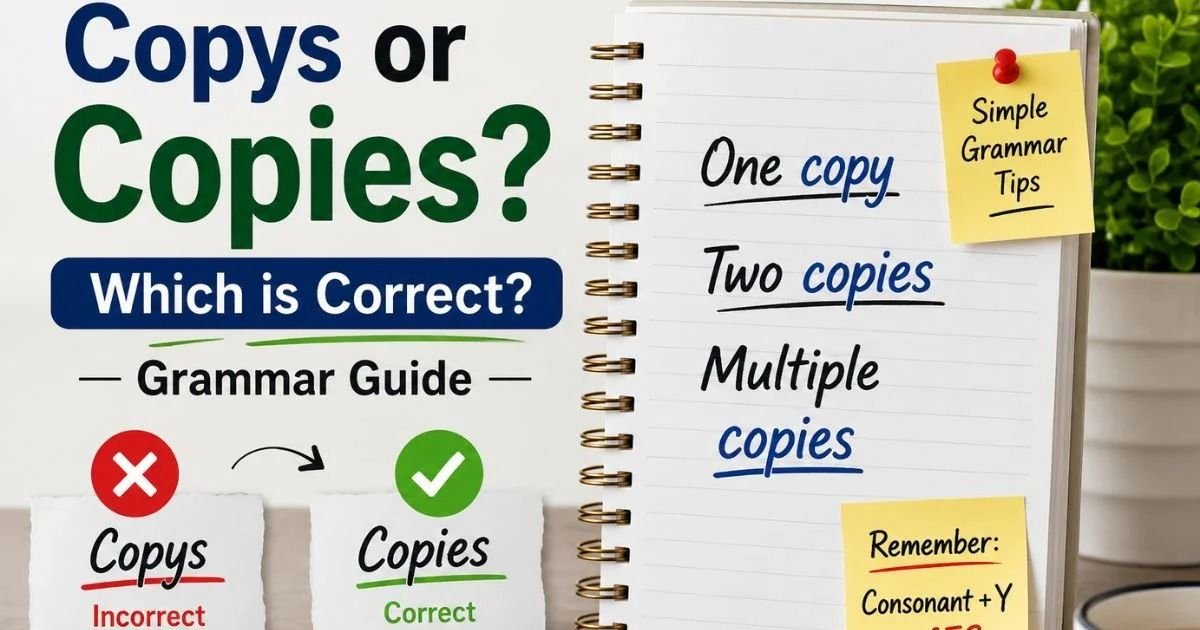
Have you ever wondered whether to write copies or copys? This is a common English spelling question, especially when writing school assignments, emails, business documents, reports, or everyday messages. Although both forms may look similar, only one is the standard spelling when you want to refer to more than one copy.
The correct spelling is copies, not copys. The word copies is the plural form of copy and also the present tense form of the verb used with subjects such as he, she, and it. The reason for this spelling is a simple English grammar rule: when a word ends in a consonant followed by the letter y, the y usually changes to ies when forming the plural.
For example, one copy becomes two copies, just as one baby becomes two babies and one story becomes two stories.
However, there is more to understand than this basic rule. The word copies can function as both a noun and a verb, while copy’s has a different meaning. Learning these differences will help you avoid spelling mistakes and write more confidently.
In this guide, you will discover the correct spelling, the grammar rules behind it, examples from everyday situations, common mistakes, and practical exercises to help you remember the difference.
Copies or Copys: Which One Is Correct?
Copies is the correct spelling in standard English. Copys is an incorrect spelling when used as the plural of copy or as the present tense verb form.
Here is a quick comparison:
| Word | Correct? | Meaning |
| Copy | Yes | One version, duplicate, or reproduction |
| Copies | Yes | More than one copy or the verb form used with he, she, or it |
| Copys | No | Incorrect standard spelling |
| Copy’s | Yes, in specific contexts | Possession or a contraction |
| Copied | Yes | Past tense of copy |
| Copying | Yes | The action of making a copy |
Consider these examples:
- Correct: I printed three copies of the report.
- Incorrect: I printed three copys of the report.
- Correct: She copies her notes into a notebook.
- Incorrect: She copys her notes into a notebook.
The correct choice depends on how the word is being used, but copies is the standard form in both examples.
If you need a quick answer for a school assignment, workplace email, or online message, remember this simple rule: write copies whenever you mean multiple copies or use copy as a present tense verb with a singular third-person subject.
What Does Copies Mean?
Copies is a word with two main grammatical uses. It can be the plural noun form of copy, or it can be a verb that describes someone or something reproducing information, an image, a design, or another item.
Understanding both meanings makes it easier to use the word correctly.
Copies as a Plural Noun
As a noun, copies refers to two or more versions of something. These versions may be printed, written, photographed, stored digitally, or reproduced in another way.
For example:
- I need two copies of my application.
- The teacher collected thirty copies of the worksheet.
- We saved several copies of the presentation.
- The shop received new copies of the book.
- Please keep copies of your important documents.
In each sentence, copies refers to multiple versions of an original item.
The word can describe physical objects, such as printed papers and books, as well as digital items, such as images, documents, videos, and computer files.
Copies as a Verb
Copies is also the present tense form of the verb copy when the subject is he, she, it, or another singular third-person noun.
For example:
- She copies the lesson into her notebook.
- He copies important files to an external drive.
- The student copies the question carefully.
- My colleague copies the information into a spreadsheet.
- The machine copies each document automatically.
In these sentences, copies describes an action rather than a number of objects.
Compare the following examples:
- Noun: I made five copies of the document.
- Verb: She copies the document every morning.
Both sentences use copies correctly, but the grammatical function changes.
Why Understanding the Meaning Matters
Recognizing whether copies is a noun or a verb helps you construct accurate sentences. It also makes the spelling rule easier to remember because the same final y to ies pattern appears in both forms.
Whenever you are unsure, identify the subject and the action or object in your sentence. If you mean multiple versions, copies is the plural noun. If you describe what a singular third-person subject does regularly, copies is the correct verb form.
Why Is Copies Correct Instead of Copys?
The spelling difference comes from a common English rule for words ending in a consonant followed by y.
When a noun ends in a consonant plus y, the usual plural formation changes the y to i and adds es. The same spelling pattern applies to many verbs when forming the present tense for he, she, or it.
The word copy ends with p followed by y. Because p is a consonant, the spelling changes when the plural is formed.
The correct process is:
- Start with the singular word copy.
- Identify the final two letters, p and y.
- Recognize that p is a consonant.
- Change y to i.
- Add es to form copies.
The result is:
Copy → Copies
The incorrect form is:
Copy → Copys
Simply adding s does not follow the standard spelling pattern for this word.
The Consonant Plus Y Rule
This rule applies to many familiar English words.
| Singular | Correct plural |
| Copy | Copies |
| Baby | Babies |
| City | Cities |
| Story | Stories |
| Family | Families |
| Party | Parties |
| Country | Countries |
| Lady | Ladies |
| Library | Libraries |
| Dictionary | Dictionaries |
These words follow the same general pattern. Their final y changes to i before the plural ending is added.
For example, a person who has one dictionary has one dictionary. A person who owns several has several dictionaries.
Similarly, one family becomes two families, and one library becomes multiple libraries.
Learning a group of related words is often easier than memorizing each spelling separately.
Does Every Word Ending in Y Change to IES?
No. The letter immediately before y determines which spelling pattern usually applies.
When a word ends in a vowel followed by y, the y generally stays unchanged and you add s.
Examples include:
| Singular | Correct plural |
| Boy | Boys |
| Toy | Toys |
| Key | Keys |
| Day | Days |
| Way | Ways |
| Journey | Journeys |
| Monkey | Monkeys |
| Donkey | Donkeys |
Notice the difference between copy and toy.
In copy, the letter before y is p, a consonant. Therefore, copies become copies.
In toy, the letter before y is o, a vowel. Therefore, toys become toys.
This distinction explains why writing copys is incorrect while writing toys is correct.
Copies vs Copys: Key Differences
The main difference between copies and copys is grammatical correctness. Copies follows standard English spelling rules, while copys does not serve as the standard plural form of copy.
The following table summarizes the difference.
| Feature | Copies | Copys |
| Standard spelling | Correct | Incorrect |
| Accepted plural of copy | Yes | No |
| Meaning as a plural noun | Multiple versions | No standard plural meaning |
| Present tense verb form | Correct with he, she, or it | Incorrect |
| Suitable for formal writing | Yes | No |
| Suitable for school assignments | Yes | No |
| Suitable for professional emails | Yes | No |
Correct Examples Using Copies
- I need four copies of the agreement.
- She copies every important detail into her notebook.
- The office printed extra copies of the form.
- He copies the files to a secure folder.
- We ordered twenty copies of the textbook.
Incorrect Examples Using Copys
- I need four copys of the agreement.
- She copys every important detail into her notebook.
- The office printed extra copys of the form.
The mistake occurs because the writer treats copy like words that form their plurals by adding s. However, copy follows the consonant plus y rule.
If you remember this one distinction, you can avoid a common spelling error in both written and digital communication.
Copy, Copies, Copy’s, Copied, and Copying Explained
Several forms of the word copy may look similar, but they perform different grammatical functions. Choosing the right form depends on whether you are discussing one item, multiple items, ownership, a completed action, or an ongoing action.
Copy
Copy is the singular noun and the base form of the verb.
As a noun, it refers to one version or reproduction of something.
Examples:
- I need a copy of the receipt.
- She saved a copy of the photograph.
- Please send me a copy of the report.
As a verb, copy describes the act of reproducing or duplicating something.
Examples:
- Please copy this paragraph.
- I will copy the document tomorrow.
- Students should copy the instructions carefully.
Copies
Copies is the plural noun form of copy. It is also the present tense form of the verb used with a third-person singular subject.
Examples as a noun:
- I bought two copies of the book.
- We keep copies of our important records.
- The library has several copies of the novel.
Examples as a verb:
- He copies the notes after every class.
- She copies the data into a spreadsheet.
- The printer copies the document clearly.
Copy’s
Copy’s is not the plural of copy. It is a possessive form or a contraction in certain sentences.
As a possessive, it indicates that something belongs to or is associated with a copy.
Example:
- The copy’s quality was excellent.
This means the quality of that particular copy was excellent.
Copy’s can also represent copy is or copy has when the surrounding sentence supports that meaning.
Example:
- The copy’s ready for review.
Here, copy’s means copy is.
Another example is:
- The copy’s been saved.
Here, copy’s means copy has.
Although copy’s is correct in these situations, it should not be used to mean multiple copies.
Copied
Copied is the past tense and past participle form of copy.
Use it when describing an action that has already happened or when constructing certain perfect and passive verb forms.
Examples:
- I copied the notes yesterday.
- She copied the information into her notebook.
- They copied the file before updating it.
- The document was copied successfully.
The spelling changes from y to i before ed is added.
The correct form is copy to copied, not copyed.
Copying
Copying is the present participle and gerund form of copy.
It describes an ongoing action or an activity treated as a noun.
Examples:
- He is copying the information.
- Copying the file took only a few seconds.
- She is copying the questions into her notebook.
- The student was copying the diagram carefully.
In this form, the final y remains unchanged and ing is added.
A Simple Comparison
| Form | Example |
| Copy | I need one copy. |
| Copies | I need three copies. |
| Copy’s | The copy’s cover is damaged. |
| Copied | I copied the information yesterday. |
| Copying | She is copying the information now. |
These distinctions are important because a small spelling change can alter the meaning of a sentence.
How to Use Copies Correctly in Everyday Writing
The word copies appears in many everyday situations. Understanding how to use it naturally can improve your writing at school, work, home, and online.
Copies in School and Education
Students frequently need copies of worksheets, assignments, notes, and examination materials. Teachers may also prepare multiple copies of a lesson or classroom activity.
Examples:
- The teacher distributed copies of the worksheet.
- I made two copies of my assignment.
- The students received copies of the reading material.
- She copies the important definitions into her notebook.
- Please bring three copies of the completed form.
If a student writes, “I need two copys of my assignment,” the sentence contains a spelling mistake. The correct sentence is, “I need two copies of my assignment.”
Copies in Offices and Business
In professional settings, copies may refer to invoices, contracts, reports, receipts, applications, or other business records.
Examples:
- Please prepare five copies of the proposal.
- We sent copies of the invoice to the finance team.
- The manager keeps copies of important agreements.
- She copies the figures into the monthly report.
- Each department received copies of the updated policy.
Correct spelling is especially useful in business communication because documents often need to appear clear, professional, and consistent.
Copies in Digital Technology
The word copies is equally common when discussing computers, smartphones, and digital storage.
A digital copy may be a duplicate of a photograph, document, presentation, video, or other file.
Examples:
- I saved two copies of the presentation.
- Always keep backup copies of important files.
- She copies her photographs to a computer.
- The software creates copies of selected documents.
- We stored copies of the files in a separate folder.
The spelling does not change just because the item is digital rather than physical.
One digital copy becomes two digital copies, just as one printed copy becomes two printed copies.
Copies in Publishing and Printing
Publishers, printers, writers, and readers use copies to describe individual printed or digital editions of written material.
Examples:
- The publisher printed thousands of copies of the book.
- I ordered two copies of the magazine.
- The author signed copies of the novel.
- The office needs extra copies of the brochure.
- The printer produced fifty copies of the flyer.
These examples demonstrate why copies is useful in contexts involving quantities and reproduction.
Copies in Personal Communication
The word also appears in ordinary conversations, text messages, and emails.
Examples:
- Can you send me copies of the pictures?
- I have two copies of the same document.
- She copies my notes when she misses class.
- Please keep copies of your travel documents.
- We made copies of the family photographs.
Even in informal communication, copies is the standard spelling.
Common Mistakes People Make With Copies
Many spelling mistakes occur because English uses several different patterns to form plurals and verb endings. The following errors are worth understanding.
Mistake 1: Adding Only S to Copy
Incorrect: I printed three copys.
Correct: I printed three copies.
Why? Copy ends in a consonant followed by y, so the y changes to i before es is added.
Mistake 2: Using Copy’s for the Plural
Incorrect: Please send me two copy’s.
Correct: Please send me two copies.
Copy’s usually indicates possession or a contraction. It does not indicate multiple copies.
Mistake 3: Writing Copyed Instead of Copied
Incorrect: He copyed the information.
Correct: He copied the information.
When forming the past tense of copy, change y to i and add ed.
Mistake 4: Writing Copie Instead of Copy
Incorrect: I need one copie.
Correct: I need one copy.
Copy is the singular form. Copies is used for the plural or the appropriate present tense verb form.
Mistake 5: Confusing Nouns With Verbs
Incorrect: She copy the notes every day.
Correct: She copies the notes every day.
In the simple present tense, a third-person singular subject usually requires the verb form copies.
However, other subjects use copy:
- I copy the notes.
- You copy the notes.
- We copy the notes.
- They copy the notes.
- She copies the notes.
The correct form depends on the subject and tense.
Mistake 6: Assuming All Words Ending in Y Follow the Same Rule
Incorrect: The shop sells many toies.
Correct: The shop sells many toys.
Toy ends in a vowel followed by y, so the y stays unchanged when forming the plural.
Remember the distinction:
- Consonant plus y: copy becomes copies.
- Vowel plus y: toy becomes toys.
Learning these patterns will help you spell many other English words correctly.
Read more: ABS Testauslösung: Meaning, ABS Testing, Causes, Symptoms, and Safety Guide
How to Remember the Correct Spelling of Copies
If you often confuse copies and copys, a few simple techniques can make the correct spelling easier to remember.
Remember the Letter Before Y
Look at the letter immediately before y.
In copy, the letter is p, a consonant. Therefore, copy becomes copies.
In boy, the letter is o, a vowel. Therefore, boy becomes boys.
This quick check is useful when you encounter an unfamiliar word ending in y.
Learn Similar Word Pairs
Practice words that follow the same spelling pattern:
- Copy becomes copies.
- Baby becomes babies.
- City becomes cities.
- Story becomes stories.
- Party becomes parties.
- Family becomes families.
When you learn these words together, the shared pattern becomes easier to recognize.
Read the Complete Sentence
Sometimes a word looks unfamiliar because you are focusing on its spelling rather than its grammatical role.
Compare these sentences:
- I printed several copies.
- She copies the notes.
- I copied the notes.
- She is copying the notes.
Reading the whole sentence helps you determine whether you need a noun, a present tense verb, a past tense verb, or an ongoing action.
Use a Simple Memory Sentence
Remember this sentence:
One copy, two copies. The y changes to i before es.
Repeat it when practicing spelling. The example is short enough to recall during an exam, assignment, or everyday writing task.
Check Your Writing Before Submitting It
If you are preparing a formal document, read it once specifically for spelling and grammar. Look for words such as copys, copyed, and incorrectly used copy’s.
A spelling checker can help identify errors, but understanding the rule allows you to correct mistakes even when an automated tool is unavailable.
Copies or Copys in American and British English
Writers sometimes wonder whether the spelling changes between American English and British English.
The answer is no. Copies is the standard spelling in both American and British English. Copys is not the accepted plural form in either variety of standard English.
The same rule applies in common educational, professional, and everyday contexts.
Examples in American English:
- I need two copies of the application.
- She copies the information into her notebook.
- The office printed several copies of the report.
Examples in British English:
- I need two copies of the application form.
- He copies the details into his notebook.
- The office printed several copies of the report.
The vocabulary or phrasing used in a particular situation may differ between regions, but the spelling of copies remains the same.
For Students in India
Students in India can use copies in schoolwork, college assignments, examinations, and formal correspondence. Whether you follow Indian, British, or American English conventions, the plural form of copy is copies.
For example:
- I submitted two copies of the application.
- The teacher asked us to prepare copies of the notes.
- She copies the important points into her notebook.
For Writers in the United States
American English follows the same spelling rule.
For example:
- I printed three copies of the contract.
- The teacher distributed copies of the assignment.
- He copies the document to another folder.
There is no regional exception that makes copys the standard plural form of copy.
Practice Quiz: Copies or Copys?
Test your understanding with the following questions. Choose the correct form for each sentence before checking the answers.
Question 1
Which sentence is correct?
- I need four copys of the document.
- I need four copies of the document.
Answer: B. Copies is the correct plural form of copy.
Question 2
Complete the sentence: She _____ the information into her notebook every day.
- copy
- copys
- copies
Answer: C. Copies is the correct present tense form for the subject she.
Question 3
Which spelling is correct for the past tense?
- Copyed
- Copied
- Copies
Answer: B. The past tense of copy is copied.
Question 4
Choose the correct plural form of baby.
- Babys
- Babies
- Babyes
Answer: B. Baby ends in a consonant followed by y, so the y changes to i before es is added.
Question 5
Which sentence uses copy’s correctly?
- I printed two copy’s.
- The copy’s cover is damaged.
Answer: B. Here, copy’s indicates that the cover belongs to a particular copy.
Question 6
What is the plural of toy?
- Toies
- Toys
- Toyes
Answer: B. The letter before y is a vowel, so the y remains unchanged.
Question 7
Complete the sentence: We saved backup _____ of the files.
- copys
- copies
- copy’s
Answer: B. Copies is the correct plural noun.
Question 8
Which sentence is grammatically correct?
- They copies the notes.
- They copy the notes.
- They copys the notes.
Answer: B. The subject they takes the base verb copy in the simple present tense.
Question 9
Choose the correct sentence.
- He copied the document yesterday.
- He copyed the document yesterday.
Answer: A. Copied is the correct past tense form.
Question 10
Which spelling rule applies to copy?
- Add only s.
- Change y to i and add es.
- Remove y and add ing.
Answer: B. Copy becomes copies because it ends in a consonant followed by y.
Frequently Asked Questions About Copies or Copys
Is copies or copys correct?
Copies is correct. It is the standard plural form of copy and the present tense form used with he, she, or it. Copys is a spelling error when used for either of these forms.
Is copys a real English word?
Copys is not the standard English spelling for the plural of copy. You should use copies in ordinary writing, schoolwork, professional communication, and formal documents. A particular brand name, username, or intentionally created label might use a nonstandard spelling, but that does not make it the standard grammatical form.
What is the plural of copy?
The plural of copy is copies.
For example, one copy of a book becomes two copies of the book. The spelling changes because copy ends in a consonant followed by y.
Why does copy become copies?
Copy becomes copies because English generally changes the final y to i and adds es when a word ends in a consonant plus y.
The same pattern appears in words such as baby and babies, city and cities, and story and stories.
Can I write two copy’s?
No. When referring to two or more items, write two copies. Copy’s indicates possession or can represent copy is or copy has in a suitable sentence. It does not form the plural.
Is copies a noun or a verb?
Copies can be either a noun or a verb.
As a noun, it means more than one version of something: “I printed three copies.”
As a verb, it describes an action performed by a third-person singular subject: “She copies the information.”
The sentence determines which grammatical role applies.
What is the singular form of copies?
The singular form is copy.
For example:
- Singular: I need one copy.
- Plural: I need three copies.
Is copies correct in American English?
Yes. Copies is the correct spelling in American English, just as it is in British English. There is no standard regional spelling difference for this word.
Is copies correct in British English?
Yes. British English also uses copies as the plural form of copy. The spelling remains the same in formal and informal writing.
What is the past tense of copy?
The past tense is copied.
For example, “I copied the information yesterday.” The final y changes to i before ed is added.
What is the difference between copied and copies?
Copied is the past tense or past participle of copy. Copies is the plural noun or the present tense verb form used with a third-person singular subject.
Examples:
- She copied the document yesterday.
- She copies the document every morning.
- I printed several copies of the document.
When should I use copy instead of copies?
Use copy when referring to one item or when using the base verb form with subjects such as I, you, we, and they.
Examples:
- I need one copy.
- They copy the information carefully.
Use copies when referring to multiple items or describing an action performed by he, she, or it in the simple present tense.
Does the y to ies rule apply to every English word?
No. The rule generally applies to words ending in a consonant plus y. When a word ends in a vowel plus y, the y usually remains unchanged and s is added.
For example, copy becomes copies, while toy becomes toys.
How can I avoid spelling mistakes with copies?
Remember the consonant plus y rule, practice similar word pairs, and review your sentences before submitting them. You can also use a spelling checker as an additional safeguard. The most important point is to recognize the difference between copies, copy’s, copied, and copying.
Can I use copies in a formal email?
Yes. Copies is appropriate for formal emails, business correspondence, reports, and applications.
For example: “Please find two copies of the completed document attached.”
What is the difference between copies and duplicates?
Copies are additional versions or reproductions of something. Duplicates are items that repeat or match another item. The words often have similar meanings, but the best choice depends on the context.
For example, you might request two copies of a report or describe two identical entries in a database as duplicates.
Conclusion
When deciding between copies or copys, the correct choice is copies. It is the standard plural form of copy and the correct present tense verb form for subjects such as he, she, and it. Copys is not the standard spelling and should be avoided in normal English writing.
The reason is straightforward. Copy ends in a consonant followed by y, so the y changes to i before es is added. The same pattern appears in words such as baby and babies, city and cities, and story and stories.
Remember that copy, copies, copy’s, copied, and copying have different grammatical functions. Copy refers to one version or serves as the base verb. Copies refers to multiple versions or an action performed by a third-person singular subject. Copy’s expresses possession or a contraction, copied describes a past action, and copying describes an ongoing action or activity.
Whether you are writing a school assignment, preparing a business report, sending an email, or discussing digital files, using copies will help you communicate clearly and correctly.
The easiest rule to remember is this: one copy, two copies, never two copys in standard English.






One Comment