
Dulcoglide: What It Is, How It Works, and Is It Safe?

If you have searched for Dulcoglide, you have probably come across a confusing mix of names. Some pages talk about it as if it were a laxative. Others describe it as an applicator. A few mention Dulcolax in the same breath, which only adds to the confusion. The short answer clears most of it up at once. Dulcoglide is a disposable applicator designed to help insert a compatible rectal suppository. It is not a medicine, it contains no laxative ingredient, and it does not treat constipation on its own.
That distinction is the key to understanding the whole product. When Dulcoglide is used with a Dulcolax bisacodyl suppository, the suppository provides the medicine and the applicator provides the delivery method. The applicator holds the suppository, helps place it, and is then thrown away. Everything else in this guide follows from that simple fact: what the device is, how it works, how to use it safely, who should avoid it, and whether it is still easy to buy.
Quick answer: Dulcoglide is a single use, individually wrapped rectal suppository applicator associated with Dulcolax bisacodyl suppositories. It has a barrel that holds the suppository and a plunger that releases it. It does not contain bisacodyl and does not stimulate a bowel movement by itself. UK pharmacy listings checked in October 2026 showed limited availability, with some packs listed as out of stock or no longer available, so anyone looking for one should ask a pharmacist about current supply and compatible alternatives.
Dulcoglide at a Glance
Here is the short version for readers who want the key facts first. The rest of this article explains each point in more detail.
| Product | Dulcoglide (also written DulcoGlide) |
| What it is | A disposable rectal suppository applicator |
| What it is not | Not a laxative and not a medicine |
| Active ingredient | None in the applicator itself |
| Used with | Compatible suppositories, mainly Dulcolax bisacodyl suppositories |
| How it works | Barrel holds the suppository, plunger releases it into the rectum |
| Reuse | No, single use only, discard after use |
| Age guidance | UK pharmacy information lists it as not suitable for children under 12 years |
| Availability | Limited in the UK as of October 2026, some listings out of stock |
| Best use | Helping adults who prefer not to insert a suppository with a finger |
What Is Dulcoglide?
Dulcoglide is a product name used for a specially designed rectal suppository applicator. UK pharmacy listings describe the device as comfort shaped, individually wrapped, and single use. It has been sold on its own as a pack of applicators, and it has also appeared in packs of Dulcolax medicated laxative suppositories. In both cases the job of the device is the same: to give people an alternative to inserting a suppository directly with a finger.
The name itself is part of the reason people get confused. Dulcoglide sounds like a medicine name, and it sits very close to Dulcolax, which is a well known laxative brand. It is easy to assume that Dulcoglide is simply another laxative, or a different strength of Dulcolax, or a cream or tablet with a similar name. None of that is correct. Dulcoglide is equipment. It is a small plastic device, and its only function is mechanical. It holds a suppository in place and then releases it where it needs to go.
That mechanical role is worth spelling out because it shapes every decision that follows. If the applicator is used without a suppository, nothing medical happens. If it is used with the wrong suppository, the medicine may not fit, may not release properly, or may not be suitable for the person using it. And if it is used carelessly, the same risks apply as with any object inserted into a sensitive part of the body. The device does not remove those risks. It only changes how the suppository gets into place.
What Is a Suppository?
A suppository is a small, solid preparation containing medicine that is inserted into the rectum, where it can dissolve or melt. The rectum is the final section of the large bowel, just inside the anus. Medicines given this way act locally, close to where they are placed, and some are also absorbed into the bloodstream. Suppositories are used for several different conditions, but the ones linked to Dulcoglide are laxative suppositories for occasional constipation.
Laxative suppositories usually have a smooth, torpedo shape with a pointed end, which helps them slide in. Dulcolax suppositories, for example, are described in their product information as smooth, white, torpedo shaped suppositories. The adult strength contains 10 mg of bisacodyl, and a children’s strength contains 5 mg. Once inside the rectum, the suppository base melts at body temperature and releases the active ingredient against the bowel wall, where it can start working.
People sometimes wonder why a suppository is used at all when laxative tablets exist. The main reason is speed. A suppository placed in the rectum acts much faster than a tablet swallowed and passed through the stomach. The NHS says bisacodyl suppositories usually work within 10 to 45 minutes, while bisacodyl tablets take about 6 to 12 hours. That speed makes suppositories useful when relief is needed the same morning, or when swallowing tablets is difficult, or when a doctor wants the bowel emptied before a medical procedure.
What Does the Applicator Look Like?
The Dulcoglide applicator consists of two main parts: a barrel and a plunger. The barrel is the hollow tube that holds the unwrapped suppository. The plunger sits inside the barrel and, when pushed, releases the suppository out of the open end. The shape is described in pharmacy listings as comfort shaped, which means the end that enters the body is rounded and smooth rather than sharp or square.
Each applicator comes individually wrapped, so it stays clean until the moment it is used. The wrapping is part of the design, not just packaging for the shelf. Because the device is used inside the body, keeping it sealed until use matters for hygiene. A damaged wrapper, a dirty applicator, or a device that has already been opened should not be used. If the packaging looks torn or the applicator looks cracked or bent, it should be thrown away and a fresh one used instead.
The applicator is made for rectal use only. It is not designed for oral use, and it is not designed for vaginal use. That may sound obvious, but it is worth stating plainly because suppository applicators for different parts of the body do exist, and they are not interchangeable. Using the wrong device in the wrong place can cause injury, and it will not deliver the medicine where it is needed.
Dulcoglide and Dulcolax: Understanding the Difference
DulcoGlide and Dulcolax are closely associated names, but they are not the same product. The confusion is understandable because the two names have appeared together on the same packs, in the same pharmacy listings, and in the same articles. Once the roles are separated, though, the picture becomes clear. One name belongs to the medicine. The other belongs to the equipment that helps deliver it.
Dulcolax is a well known medicine brand that includes bisacodyl laxative preparations. Bisacodyl is a stimulant laxative. It works by stimulating the muscles of the bowel wall, encouraging them to contract and move stool along, and by increasing the amount of water in the bowel. Dulcolax products include tablets taken by mouth and suppositories inserted into the rectum. The tablets and the suppositories contain the same active ingredient, but they work on very different timescales because they reach the bowel by different routes.
DulcoGlide, by contrast, refers to the applicator that has been offered alongside Dulcolax suppositories. Historical product information includes packs combining 10 mg bisacodyl suppositories with disposable applicators. In those packs, the suppositories do the medical work and the applicators do the handling work. Buying such a pack does not mean the applicator itself has any laxative effect. It means the buyer gets both parts of the system in one box.
| Product or component | Main purpose | Contains laxative medicine? |
| Dulcoglide applicator | Helps administer a compatible rectal suppository | No |
| Dulcolax bisacodyl suppository | Treats occasional constipation | Yes, bisacodyl 10 mg for adults |
| Dulcolax bisacodyl tablets | Oral treatment for constipation | Yes, bisacodyl |
| Applicator and suppository combination pack | Provides the medicine and an administration device together | The suppository does, the applicator does not |
Understanding this difference also helps when reading pharmacy listings and old product pages. A listing for Dulcoglide applicators on its own is a listing for equipment, and its price reflects that. A listing for Dulcolax suppositories with DulcoGlide applicators is a listing for a combined pack. The two should not be compared as if they were the same kind of product, and a shopper who only needs the medicine should not pay extra for applicators they do not want, just as a shopper who only needs applicators should not assume the pack contains medicine.
How Does the Applicator Work?
The device works through a relatively straightforward mechanical process. A compatible, unwrapped suppository is placed in the applicator barrel. The device is then positioned according to its instructions, and the plunger releases the suppository into the rectum. After the medicine is delivered, the applicator is removed and discarded. The whole process takes only a short time, but each step matters, and skipping the preparation or rushing the insertion is where most problems begin.
The applicator itself does not dissolve, release a medicinal ingredient, or stimulate the bowel. Those effects depend entirely on the suppository being used. This is why the instructions for the medicine and the instructions for the applicator both need to be read. The medicine leaflet explains the dose, the warnings, and how long the medicine takes to work. The applicator instructions explain how to load the device and how far to insert it. Neither leaflet replaces the other.
Some people may prefer an applicator because they find direct insertion uncomfortable or difficult. That preference is personal, and it is a reasonable one. Inserting a suppository with a finger can feel awkward, unhygienic, or physically difficult for people with limited mobility, arthritis in the hands, or pain around the anus. An applicator keeps the fingers away from the medicine and gives the user a handle to hold. Comfort, however, is individual, and no applicator should be assumed to eliminate discomfort or injury risk. A comfort shaped tip helps, but it does not make forceful insertion safe.
Key Features of the Applicator
The documented product design includes several practical characteristics, and each one tells you something about how the device is meant to be used.
- Single use construction: the applicator is intended to be discarded after one use. It is not designed to be washed, sterilised, and used again.
- Individual wrapping: each device is packaged separately before use, which keeps it clean until it is opened.
- Plunger mechanism: the plunger releases a compatible suppository once the applicator is correctly positioned.
- Comfort shaped design: the shape is intended to assist rectal administration and to reduce discomfort during insertion.
- Rectal application only: the device is designed for rectal use, not for oral or vaginal administration.
- No medicine inside: the applicator holds the suppository but contains no active ingredient of its own.
These features describe the equipment rather than providing evidence that it works better than every other insertion method. A standard suppository inserted with a finger, following the leaflet, is a well established method that works for most people. The applicator is an alternative for people who prefer it, not a requirement, and not a sign that the finger method is wrong or unsafe when done correctly.
How to Use a DulcoGlide Applicator
Correct handling is essential because the applicator is inserted into a sensitive part of the body. The steps below summarise instructions previously published for the disposable product. They are a guide to understanding the process, not a replacement for the leaflet that comes with the actual product. Always follow the leaflet supplied with the product you have in your hand, because packaging and instructions may differ between packs and over time.
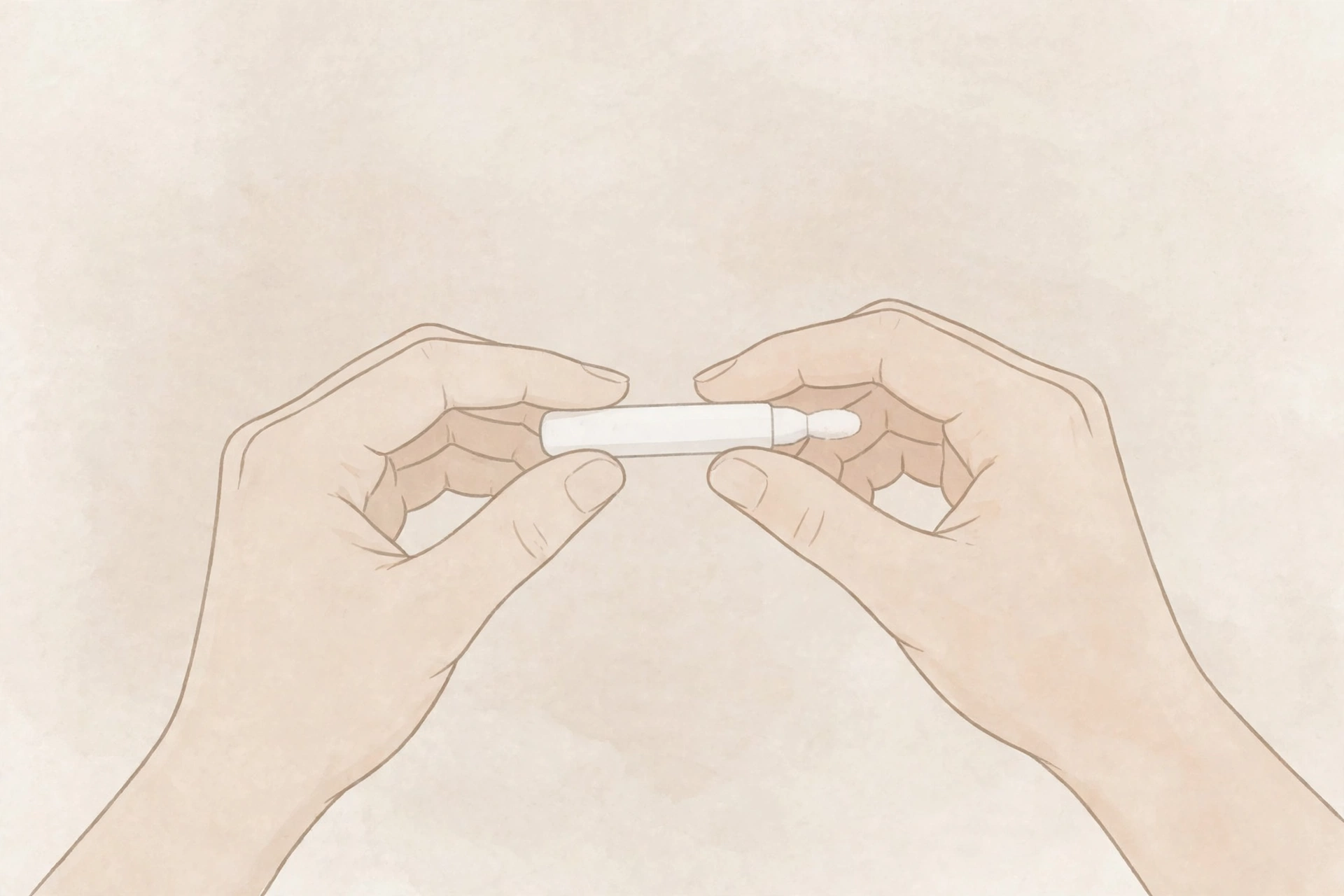
Step 1: Confirm the Product Is Suitable
Check that the suppository is compatible with the applicator and is appropriate for the person using it. Read the medicine leaflet, including the recommended dose and the warnings. Do not assume that every suppository will fit or can safely be administered using the device. Suppositories come in different sizes and shapes, and an applicator designed for one size may not hold another properly. A suppository that is too large may jam in the barrel. One that is too small may fall out or release too early.
Also check the age guidance before going any further. UK pharmacy information for the applicator identifies it as unsuitable for children under 12 years. The age guidance for the applicator must be considered separately from the age guidance for the medicine, because the two products have their own rules. For younger people, a doctor or pharmacist should determine whether a particular treatment and administration method are appropriate. Never use an adult applicator on a child because it seems convenient.
Step 2: Prepare the Equipment
Wash your hands thoroughly with soap and water. Remove the applicator from its individual wrapper and unwrap the suppository. Place the suppository into the open end of the applicator barrel as directed by the product instructions. Do not force it into position. If it does not sit in the barrel easily, stop and check whether you have the right suppository for the device. Forcing a suppository can damage it, and a damaged suppository may crumble or melt unevenly.
Check the applicator itself before loading it. Look for cracks, rough edges, or any sign of damage. Check that the plunger moves freely. If anything looks wrong, throw that applicator away and open a fresh one. This is also the moment to make sure you are near a toilet, or can reach one quickly afterwards, because bisacodyl suppositories can work within minutes. Having everything ready before you start avoids rushing later.
Step 3: Position Yourself
The published instructions describe lying on your side with your lower leg straight and your upper leg bent toward your chest. This position may make administration more manageable, because it relaxes the muscles around the anus and gives a clear angle for the applicator. Some people prefer to lie on their left side, which is the position most suppository leaflets describe. Others find a slightly different angle more comfortable. The important thing is to be relaxed and stable, not twisted or straining.
If you have difficulty positioning yourself, seek advice rather than attempting an uncomfortable movement. People with back pain, hip problems, or limited mobility may find the lying position hard to reach or hard to hold. A pharmacist or nurse can suggest an alternative position or an alternative way to take the medicine. There is no benefit in struggling through a position that causes pain, because tension makes insertion harder and increases the chance of injury.
Step 4: Insert and Release
Hold the applicator as directed in the leaflet and carefully follow the insertion instructions. Guide the tip gently into the rectum. The plunger is used to release the suppository once the applicator is correctly positioned. Push the plunger smoothly, without jerking it, and then hold still for a moment so the suppository stays in place when the applicator is withdrawn.
Never force the applicator. Stop if you experience pain, unusual resistance, or bleeding, and seek appropriate medical advice. Pain is a signal that something is wrong, and pushing past it can tear delicate tissue. If the applicator will not go in easily, the angle may be wrong, the muscles may be tense, or there may be a sore or swelling in the way. In that case, stop, relax, and try again later, or ask a pharmacist for advice. Do not try a different object as a substitute for the applicator.
Step 5: Remove and Dispose
Carefully remove the device after the suppository has been released. Dispose of the used applicator in household waste as directed by its instructions. Do not reuse it or flush it down the toilet. Flushing can block pipes, and the applicator is not designed to break down in water. Wash your hands afterwards with soap and water.
After use, try to stay near a toilet. The suppository needs time to melt and work, and the urge to go can arrive quickly. Patient leaflets for bisacodyl suppositories advise keeping the suppository inside for as long as possible, with some leaflets suggesting at least 30 minutes where that is practical, because this is how long the medicine takes to work properly. If the suppository slips out straight away, it may not have been inserted high enough. Do not simply insert another one without checking the leaflet or asking a pharmacist, because taking an extra dose can cause cramps and diarrhoea.
How Quickly Do Bisacodyl Suppositories Work?
When the applicator is used with a bisacodyl laxative suppository, it is the medicine that produces the bowel movement. The applicator does not speed up the medicine, and it does not slow it down. Its job ends the moment the suppository is released. From that point on, the timing depends on the medicine, the dose, and the individual person.
According to NHS guidance, bisacodyl suppositories generally work within 10 to 45 minutes, whereas oral bisacodyl tablets usually take approximately 6 to 12 hours. Other product information may describe a window of 15 to 60 minutes. These ranges reflect different published guidance, not a guaranteed response time, and the difference between them is not a contradiction. Different sources measure the effect slightly differently, and individual bodies respond at different speeds. What they agree on is the broad picture: suppositories act in minutes, tablets act in hours.
People using a laxative suppository should normally remain near a toilet because the effect can occur relatively quickly. This is practical advice, not a warning about danger. It simply avoids the embarrassment and rush of being caught far from a bathroom when the medicine starts to work. Using the suppository in the morning, when there is time to stay at home, is the usual pattern described in NHS guidance, which gives the standard adult dose as one 10 mg suppository once a day in the morning.
Benefits and Limitations
The main potential benefit of a disposable applicator is convenience during administration. It delivers a compatible suppository without direct finger insertion, which some people find cleaner and less awkward. Individual packaging and single use construction also support straightforward handling and disposal when the instructions are followed. There is no cleaning to do afterwards, no device to store, and no question about whether it is still hygienic for next time, because there is no next time for that applicator.
Yet there are limitations, and they deserve equal weight. First, not every suppository is suitable for a particular applicator. Compatibility should be confirmed before use, and a mismatch can waste a dose or deliver it badly. Second, the device does not replace medical advice about constipation or the medicine being administered. It is a delivery aid, not a treatment plan, and it cannot tell you whether bisacodyl is the right laxative for you. Third, proper technique remains essential. A comfort shaped design does not make forceful insertion safe, and a plunger does not protect against injury if the device is pushed too hard or at the wrong angle.
Finally, an applicator is not essential for everyone who uses a suppository. Standard suppository instructions commonly describe direct insertion with a finger, and that method may be suitable when performed correctly. For many people, the finger method is simple, reliable, and free, and buying applicators adds cost without adding benefit. The honest way to judge the product is to ask whether it solves a real problem for you. If inserting a suppository with a finger is uncomfortable, difficult, or unhygienic in your situation, an applicator may help. If it is not a problem, the applicator is an optional extra rather than a necessity.
Is Dulcoglide Safe?
Safety has two separate parts here, and they should not be mixed up. The safety of the applicator is about the device itself: whether it can injure the rectum, whether it can be used hygienically, and who should not use it. The safety of the medicine is about bisacodyl: its side effects, its interactions, and the conditions in which it should not be used. A person using both together needs to consider both parts.
On the device side, the main risks come from incorrect use rather than from the applicator being inherently dangerous. Gentle insertion following the leaflet is the normal expectation. Forcing the device, using a damaged applicator, reusing a single use device, or using it on a child under 12 against the stated guidance all increase the risk of pain, tearing, or infection. The single use rule is part of safety, not just convenience. A reused applicator can carry bacteria into a sensitive area, and a washed applicator may be weakened or misshapen in ways that are hard to see.
On the medicine side, the NHS lists the most common side effects of bisacodyl as feeling sick, diarrhoea, and stomach pain or cramps. These happen in more than 1 in 100 people, and they are usually mild and pass after a couple of days. Other product information also mentions rectal discomfort, faintness, rectal burning, and mild cramps. These effects come from the medicine, but incorrect use of an applicator can also cause local injury, so it is not always easy to tell which part caused a particular symptom. If pain or bleeding follows use, that needs medical attention regardless of the cause.

Who Should Not Use Bisacodyl Suppositories?
Bisacodyl suppositories are unsuitable for some individuals, and the applicator does not change that. Speak with a healthcare professional before using them if you have severe abdominal pain, nausea or vomiting, a suspected bowel obstruction, significant dehydration, or certain inflammatory bowel conditions. These are situations where stimulating the bowel could make things worse, and a doctor needs to work out what is happening before any laxative is used.
People with anal fissures, sores, or other painful rectal conditions should obtain advice before using an insertion device. A fissure is a small tear in the skin around the anus, and inserting anything into that area can be painful and can slow healing. Haemorrhoids, which are swollen veins around the anus, can also make insertion uncomfortable. In these cases a pharmacist may suggest a different form of treatment, or a way to make insertion gentler, or a referral to a doctor if the condition needs treatment first.
Pregnant individuals should consult a healthcare professional before using bisacodyl. Although the NHS provides guidance on its possible use during breastfeeding, individual circumstances still matter, and a pharmacist can confirm whether it is suitable in a particular case. Children need separate advice too. The NHS gives the usual dose for children aged 4 to 9 years as one 5 mg suppository once a day, but only on a doctor advice, and children under 12 should not use the Dulcoglide applicator according to the UK pharmacy information. Those two rules sit side by side, and both need to be respected.
Possible Side Effects
Bisacodyl may cause abdominal cramps, diarrhoea, nausea, or rectal discomfort. These are the effects most commonly reported, and they are usually short lived. The cramps happen because the medicine stimulates the bowel muscles to contract, and those contractions can feel uncomfortable, especially if the bowel is full. Diarrhoea happens when the bowel moves too strongly or too much water is drawn in, and it usually settles once the medicine has passed through.
More serious effects are rare but need to be recognised. Seek medical advice if symptoms persist or are concerning. Rectal bleeding after use requires prompt assessment. Severe abdominal pain, substantial bleeding, or signs of a serious allergic reaction require urgent medical attention. An allergic reaction might include swelling of the face or throat, difficulty breathing, or dizziness. These are not common, but knowing what to watch for means help can be sought quickly if they happen.
There is one more safety rule that applies to bisacodyl in general. NHS guidance advises against using bisacodyl daily for more than five days without medical advice. Frequent or prolonged laxative use can lead to problems such as diarrhoea or disturbances in the body fluid and electrolyte balance, and the bowel can start to rely on the laxative rather than working on its own. If constipation continues or keeps returning, assessing the underlying cause is more useful than relying indefinitely on short term treatment. That assessment might look at diet, fluid intake, medicines, activity levels, or an underlying health condition.
Is Dulcoglide Still Available in the UK?
Availability appears limited based on the UK pharmacy listings checked in October 2026. Express Chemist lists a three pack of applicators as no longer available, while other UK pharmacy pages show out of stock product listings. These findings do not establish that the device has been discontinued everywhere. Pharmacy stock, distribution, and product ranges change over time, and an old listing is not proof of current supply. A product can be out of stock in one shop and available in another, or temporarily unavailable while a supplier changes.
A historical US trademark record also shows a cancellation in December 2021, but trademark status alone does not establish whether a physical product is being manufactured or sold. The US trademark for DULCOGLIDE was granted in June 2015, covering products including laxatives, suppositories, and suppository applicators, and it was subsequently cancelled in December 2021. A cancelled trademark can mean many things. It can mean the owner stopped using the name, or stopped paying the renewal fees, or decided the registration was no longer needed. It does not by itself prove that the applicators stopped being made.
Anyone looking for an applicator should ask a pharmacist whether a suitable device is available and whether it is compatible with their prescribed or over the counter suppository. A pharmacist can also suggest alternatives if the Dulcoglide applicator is not in stock, including other applicators or the standard finger insertion method described in the medicine leaflet. That conversation is more reliable than ordering from an unfamiliar website based on an old listing, because the pharmacist can check what is actually available and whether it fits the suppository you have.
A Short History of Dulcoglide and Dulcolax Suppositories
The DulcoGlide applicator is not a new idea that appeared out of nowhere. It comes from a period when Dulcolax, then owned in the consumer health market by Boehringer Ingelheim, was looking for ways to make suppositories easier to use. A report in Drug Topics dated October 15, 2013 described Dulcolax Laxative Suppositories with New DulcoGlide Applicators, developed by Boehringer Ingelheim Pharmaceuticals. The report said the bisacodyl suppositories provided relief in 15 minutes to one hour, and that the applicators offered a mess free option for suppository placement. Each suppository came individually wrapped, and the product could be used once daily for one week if needed, by adults and children 12 years of age and older.
That 2013 launch is useful context because it shows what problem the applicator was meant to solve. Suppositories work well, but many people dislike inserting them. The mess, the awkwardness, and the hygiene worry put people off, even when the medicine itself is effective. An applicator was a practical answer to that reluctance. It did not change the medicine, and it did not claim to make the medicine work faster. It simply made the act of using it feel cleaner and easier.
Since then, the ownership and presentation of Dulcolax have changed. The Dulcolax brand has moved through different consumer healthcare owners, and the current marketing authorisation holders in different countries are not the same companies that launched the applicator in 2013. That is normal for a long running medicine brand. What has not changed is the basic distinction between the medicine and the device. Whatever company sells the suppositories today, the applicator remains a separate piece of equipment with a separate job.
Alternatives for Managing Constipation
A suppository applicator is only one element of a much wider range of constipation treatments. For many adults, initial management involves reviewing fluid intake, dietary fibre, physical activity, and regular toilet habits. These sound simple, and they are, but they are also the steps that guidelines recommend first, because they address the common causes of constipation rather than just the symptom. Drinking enough water, eating fibre rich foods, moving regularly, and not ignoring the urge to go can make a real difference over days and weeks.
When additional treatment is needed, pharmacists may recommend different types of laxatives based on individual needs. Bulk forming products such as ispaghula husk and osmotic laxatives such as macrogol are commonly considered before stimulant laxatives in routine constipation management. Bulk forming laxatives work by absorbing water and swelling in the bowel, which makes the stool softer and bulkier and easier to pass. Osmotic laxatives work by drawing water into the bowel, which softens the stool. Stimulant laxatives such as bisacodyl work more directly on the bowel muscles, which is why they act faster but are also more likely to cause cramps.
Suppositories may be useful in particular circumstances, especially when a faster acting rectal treatment is appropriate. Glycerin suppositories, for example, are another rectal option. They work mainly by drawing water into the bowel and by irritating the lining slightly, and they often work within about 15 minutes. They are sometimes preferred for people who need gentle, occasional help. However, treatment choice should be based on the underlying problem, medical history, and advice from a qualified professional, not on which product is advertised most heavily or which one a friend recommended.
Anyone experiencing persistent constipation, unexplained weight loss, blood in their stool, or a significant change in bowel habits should arrange a medical assessment. These symptoms can have causes that a laxative will not fix, and in some cases they need investigation rather than self treatment. A doctor can check for underlying conditions, review medicines that may cause constipation, and arrange tests if needed. Reaching for another laxative instead of getting checked is a common mistake, and it can delay a diagnosis that matters.
What to Consider Before Choosing an Applicator
The most useful first question is whether you actually need an applicator. Someone who can administer a suppository comfortably using the standard instructions may not need additional equipment. The finger method is described in every bisacodyl suppository leaflet, and it is the method that most guidance assumes. It costs nothing extra, it needs no special purchase, and it works. If that method is fine for you, an applicator adds little.
If an applicator is preferred, its compatibility, age restrictions, packaging integrity, and instructions deserve careful attention. Check that the device is new, individually wrapped, and undamaged. Avoid products with unclear instructions or uncertain suitability. If the pack does not say which suppositories it fits, or the leaflet is missing, do not guess. A pharmacist can confirm whether the applicator you have will work with the suppository you have, and can suggest a different product if it will not.
If difficulty inserting suppositories is related to pain, limited mobility, or an existing medical condition, speak to a pharmacist or healthcare professional for a more appropriate solution. The difficulty may have a cause that an applicator cannot fix, such as a fissure, a prolapse, or severe haemorrhoids, and treating that cause may be more helpful than buying equipment. In other cases, a different form of laxative altogether, such as an oral product or a microenema, may be easier to use. A short conversation with a pharmacist can save money and discomfort.
Common Mistakes to Avoid
Most problems with suppository applicators come from small mistakes rather than from the product itself. Knowing the common ones in advance makes them easier to avoid.
- Treating the applicator as the medicine: Dulcoglide contains no bisacodyl. Using it on its own will not relieve constipation.
- Reusing a single use applicator: washing and reusing it risks infection and damage that may not be visible.
- Forcing insertion: pain, resistance, or bleeding means stop, not push harder.
- Using the wrong suppository size: a suppository that does not fit the barrel may release badly or not at all.
- Using it on a child under 12: the applicator is listed as not suitable for children under 12, even if the medicine itself has a children’s dose.
- Using bisacodyl for too long: do not use it every day for more than five days without medical advice.
- Swallowing a suppository: suppositories are for rectal use only and must never be taken by mouth.
- Flushing the applicator: dispose of it in household waste as directed, not in the toilet.
Each of these mistakes is easy to make when the instructions are skipped, and each is easy to avoid when the leaflet is read first. The leaflet is not a formality. It is the one document that describes the exact product in your hand, including its dose, its warnings, and its disposal instructions. If the leaflet is missing, ask the pharmacist for a replacement or for the information in another form before using the product.
Dulcoglide Pros and Cons
No product is perfect for every person. Here is a balanced summary of what the Dulcoglide applicator does well and where it falls short.
| Pros | Cons |
| No direct finger insertion needed | Does not treat constipation on its own |
| Individually wrapped and hygienic for one use | Only fits compatible suppositories |
| Simple barrel and plunger design | Not suitable for children under 12 |
| Can help people with limited hand mobility | Single use, so it adds cost and waste |
| Available in combination packs with Dulcolax | Limited UK availability as of October 2026 |
| Comfort shaped tip for easier insertion | Does not remove the need for correct technique |
Frequently Asked Questions
What is Dulcoglide used for?
Dulcoglide is a disposable rectal applicator designed to help insert compatible suppositories. It has been associated with Dulcolax bisacodyl suppositories used for occasional constipation. The applicator holds the suppository and releases it into the rectum, so the user does not have to insert it with a finger.
Does Dulcoglide contain bisacodyl?
No. The applicator itself does not contain bisacodyl or any other active ingredient. The medicine may be supplied separately alongside the device or purchased separately. When Dulcoglide is used with a Dulcolax suppository, the suppository contains the bisacodyl, and the applicator only delivers it.
Is Dulcoglide a laxative?
No. Dulcoglide is not a laxative. A laxative is a medicine that stimulates a bowel movement, and the applicator has no medicinal effect. The laxative effect comes entirely from the suppository used with it, such as a bisacodyl suppository.
Can children use a DulcoGlide applicator?
The UK product information states that the applicator is not suitable for children under 12 years. Children and teenagers should use rectal medicines only with appropriate medical or pharmaceutical guidance. A doctor or pharmacist can advise on the right treatment and the right way to give it for a child.
Can the applicator be washed and reused?
No. The documented applicator is single use. It should be discarded after administration rather than washed, sterilised, or reused. Reusing it risks infection and may damage the device in ways that make the next use less safe.
How long does a bisacodyl suppository take to work?
According to NHS guidance, bisacodyl suppositories generally work within 10 to 45 minutes. Other product information describes a window of 15 to 60 minutes. Either way, it is best to stay close to a toilet after use, because the effect can arrive quickly. Bisacodyl tablets take much longer, about 6 to 12 hours.
Has Dulcoglide been discontinued?
Some UK pharmacy listings identify the product as out of stock or no longer available, based on checks in October 2026. However, the available evidence does not conclusively establish worldwide discontinuation. A pharmacist can advise on current supply and suitable alternatives, and pharmacy stock can change over time.
Do I need an applicator to use a suppository?
No. The standard method described in bisacodyl suppository leaflets is direct insertion with a finger, and that method works for most people. An applicator is an optional aid for people who prefer it, for example because finger insertion is uncomfortable or physically difficult. It is not a requirement.
Final Words
Dulcoglide is a disposable rectal suppository applicator supplied separately and with certain Dulcolax laxative products. It assists administration, not the medicinal effect itself. That one sentence is the whole product in a nutshell, and keeping it in mind prevents most of the confusion around the name. The applicator is equipment. The suppository is the medicine. The two work together, but they are not the same thing.
The key considerations are correct product identification, suppository compatibility, careful handling, and appropriate medical guidance. Check that the suppository fits the applicator, that the medicine is suitable for the person using it, and that the leaflet instructions are followed step by step. Do not force the device, do not reuse it, and do not use it on a child under 12. If constipation keeps returning, or if there are warning symptoms such as bleeding, severe pain, or unexplained weight loss, the right next step is a medical assessment, not another laxative.
Although the listings reviewed show limited UK availability, the device remains a useful example of how administration accessories can support the use of rectal medicines. For people who find suppositories awkward or difficult to insert, a well designed applicator can make a real difference to comfort and confidence. For everyone else, the standard method described in the medicine leaflet remains a simple and effective option. If you want to read the official NHS guidance on bisacodyl, including doses and side effects, you can find it at the NHS bisacodyl page.
We publish the same kind of plain English website and product guides here on WishesHeart. If you found this explainer useful, you may also want to read our Megazee.com guide, our Voddler.co.uk guide, and our Monkey GG2 guide, which follow the same approach: what the thing is, how it works, and what to watch out for. You can find more guides like this on the WishesHeart homepage, including our RealGlobal.co.uk guide.