
ImportPellet: What It Is, What It Offers, and Is It Legit?
If you have typed importpellet into a search box, you probably want a straight answer to a simple question: what is it? The name sounds like a company, a product, or maybe a certification for wood pellets. The honest answer is that it can mean two different things, and which one matters to you depends on why you are searching. In the general sense, importpellet describes the business of importing wood pellets from overseas suppliers. In the specific sense, ImportPellet is the name of a wood pellet sourcing research brand run by Mello Commodity, built to help international buyers investigate suppliers in Brazil.
This guide explains both meanings, because confusing them can cost a buyer time and money. We look at what ImportPellet offers, what its Brazilian suppliers guide actually contains, how wood pellet importing works in practice, which quality standards matter, what the real costs look like, and where the risks sit. Everything here is based on a fresh check of the live sources in November 2026, including the Mello Commodity website and the reference guide on the subject, so you get a current picture rather than recycled claims.
Quick answer: ImportPellet is a sourcing research brand, not a pellet seller, not a marketplace, and not a certification. Its main resource is the Brazilian Wood Pellet Suppliers Guide 2026, which brings together research on 17 Brazilian producers, exporters, and trading companies. Buyers still contact suppliers directly, negotiate their own deals, and arrange their own inspection, shipping, and customs. Used that way, as a starting point for due diligence, it can save a buyer a lot of early research time.
ImportPellet at a Glance
Here is the short version for readers who want the key facts first. The rest of this article explains each point in more detail.
| Name | ImportPellet |
| What it is | Wood pellet sourcing research brand run by Mello Commodity |
| Main resource | Brazilian Wood Pellet Suppliers Guide 2026 |
| Suppliers covered | 17 Brazilian producers, exporters, and trading companies |
| Does it sell pellets? | No, buyers deal directly with suppliers |
| Is it a certification? | No, ENplus is the separate quality certification |
| Focus markets | Europe, Japan, and South Korea |
| Key quality standard | ENplus A1 for premium heating pellets |
| Best use | Supplier discovery and import preparation |
What Is ImportPellet?
ImportPellet is best understood as a research and guidance brand for the wood pellet trade. It is used by Mello Commodity for educational content and supplier research aimed at overseas buyers who are interested in Brazilian wood pellets. Its published material explains how to find producers and exporters, how to judge pellet quality, how to compare prices fairly, and how to prepare for the practical steps of an international purchase.
That description matters because the name invites misunderstanding. A buyer who finds the name in search results might reasonably assume that ImportPellet is an online store where fuel can be ordered, a certification mark printed on bags of pellets, or a shipping service that moves cargo from Brazil to Europe. It is none of those things. It does not hold stock, it does not take orders, it does not negotiate contracts on a buyer’s behalf, and it does not guarantee that any supplier will deliver what it promises. Its job is to organise the research stage so a buyer arrives at supplier conversations better prepared.
The name also has a second, wider meaning. In biomass trading generally, importpellet is used as a plain descriptive term for sourcing pellets from suppliers in another country and arranging delivery into a domestic market. The word simply combines importing with pellet fuel, a processed product made mainly from compressed woody material such as sawdust and shavings. When a general article uses the term this way, it is talking about the trade itself, not about the Mello Commodity brand. Both uses are legitimate, which is why this article keeps them separate: the trade term first, then the brand, so you can tell which one any given page is talking about.
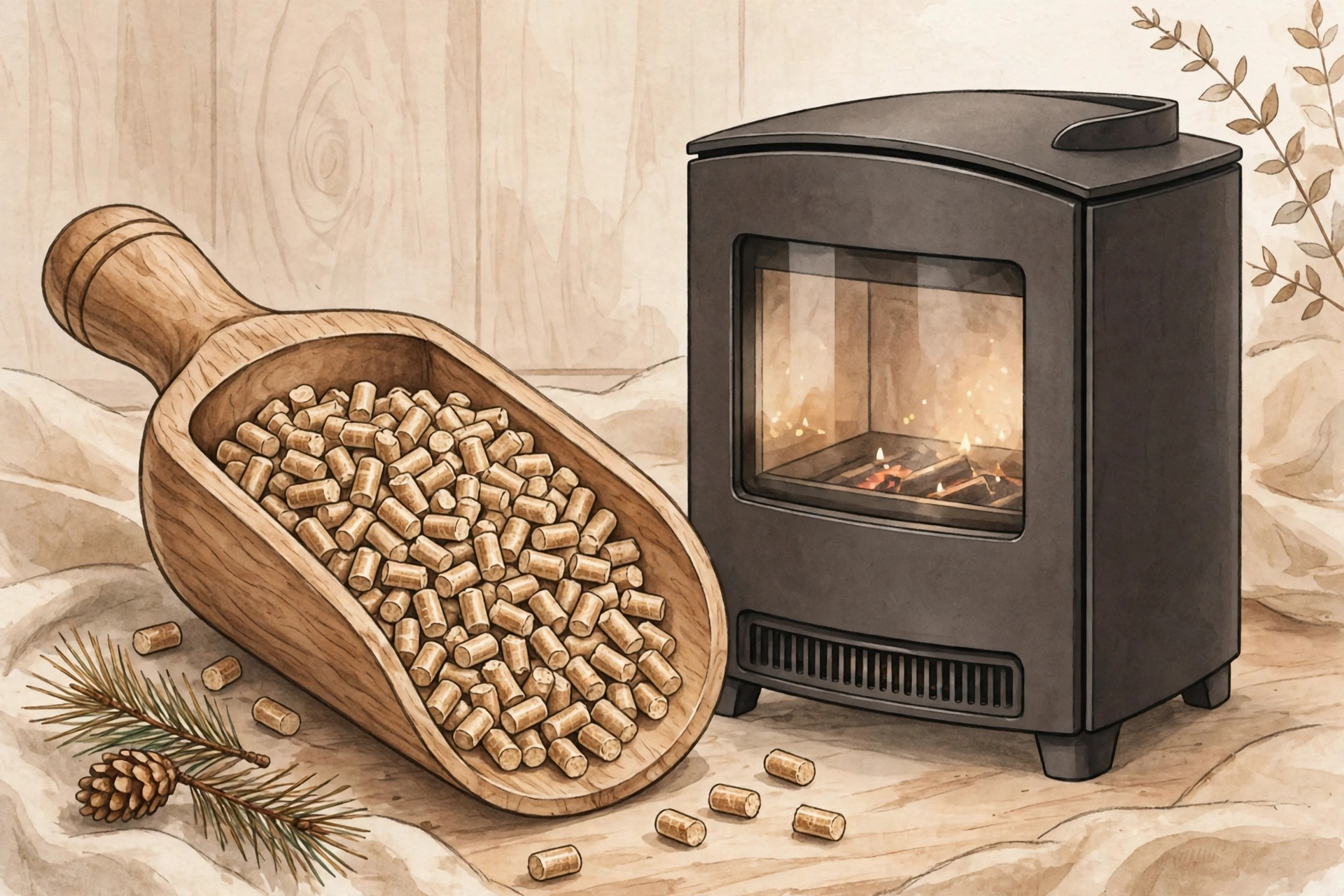
Wood pellets themselves are small cylinders of compressed biomass fuel. Manufacturers dry the feedstock and press it into uniform pieces that feed automatically into pellet stoves, boilers, and industrial combustion systems. They are supplied in small bags for domestic customers or in bulk for commercial and industrial users. Their consistent size and shape make them easier to store, transport, and feed into equipment than loose sawdust, although real performance always depends on the pellet specification and whether it suits the equipment burning it.
What Does ImportPellet Offer?
The core of what ImportPellet offers is research, organised in a way a buyer can act on. Its main resource is the Brazilian Wood Pellet Suppliers Guide 2026, and the supporting articles on the Mello Commodity website walk through the decisions a buyer faces before signing a contract. None of this replaces the buyer’s own checks, but it narrows the field and structures the questions to ask.
The Brazilian Wood Pellet Suppliers Guide 2026
The 2026 guide covers 17 Brazilian businesses selected for international buyers, grouped by their commercial role. That grouping is genuinely useful because a producer, an exporter, and a trading company do different jobs. A producer manufactures the fuel. An exporter manages overseas sales. A trading company may coordinate purchases between manufacturers and buyers. Knowing which role a company performs helps you ask the right questions about production, export records, and who is responsible if a shipment goes wrong.
According to the published descriptions of the guide, its contents include business contacts, evidence of international market activity, ENplus information where applicable, a request-for-quotation structure, and a due-diligence checklist. The RFQ template is one of the more practical parts. It lets a buyer send the same brief to every shortlisted supplier, so the quotes that come back can be compared on the same specification, quantity, packaging, delivery basis, and time window, instead of arriving in different formats that hide the real differences.
Import Preparation Guidance
Alongside the guide, ImportPellet publishes step-by-step material on the import process itself. This covers defining a product specification, checking the destination market’s rules before negotiating, shortlisting suppliers and requesting documents, comparing quotes on the same commercial terms, negotiating the contract, arranging payment security, organising freight and insurance, arranging independent inspection at loading, reviewing shipping documents, and clearing customs. It is the unglamorous paperwork side of importing, and it is where most first-time deals go wrong.
What ImportPellet Does Not Do
The limits are as important as the offer. ImportPellet does not sell fuel, hold inventory, or show live stock levels. It does not negotiate prices, book vessels, clear customs, inspect cargo, or act as a legal adviser. It cannot guarantee a supplier’s production capacity, product quality, payment security, or delivery performance. A research guide can shorten the time spent finding companies, but it cannot remove the risk from the transaction. Treat it as a starting point for due diligence, not as proof that a listed supplier suits your order.
Why Are Buyers Looking at Brazilian Wood Pellets?
Brazil has become a meaningful origin in the international wood pellet trade, supported by its forestry and wood-processing industries. Pine and eucalyptus grow in short cycles, which supports a steady raw-material base, and the large forestry sector in southern Brazil generates sawdust and shavings, the feedstock for premium pellets. Export-ready ports such as Paranagua, Itapoa, Santos, and Rio Grande handle containers and bulk cargo regularly, and production and inland logistics costs in Brazil can translate into competitive offers at the factory gate.
The trade figures give a sense of scale. Brazil exported 449,000 tonnes of pellets in 2025, with Italy receiving almost 70 percent of that volume. Italy alone imported approximately 348,000 tonnes of pellets from Brazil in 2025, an increase of 11 percent on the previous year. Those numbers show real, growing trade activity, and they explain why importers have reason to assess Brazilian suppliers. Export growth alone, however, does not prove that any individual producer can meet a particular buyer’s requirements, and Brazil is one sourcing option, not an automatic low-cost choice.
European, Japanese, and Korean buyers have spent years concentrating supply in a few origins, and concentration means exposure to price spikes, logistics bottlenecks, and geopolitical risk. Brazil offers diversification. The International Energy Agency has reported that global wood pellet trade exceeded 40 million metric tons in 2023, which confirms that this is a high-volume, competitive market where a new origin has to earn its place on quality and reliability, not on price alone. Buyers should compare Brazilian offers with suppliers closer to the destination and include freight, handling, duties, and delivery time in the comparison. The right origin meets the specification at a reliable total cost, not simply the lowest factory price.
We publish the same kind of plain-English website and business guides here on WishesHeart. If you found this explainer useful, you may also want to read our Megazee.com guide and our RealGlobal.co.uk guide, which follow the same approach: what the site is, what it offers, and what to watch out for.

Wood Pellet Quality: What ENplus A1 Really Means
Fuel quality deserves particular attention because pellets that look similar can behave very differently in boilers and stoves. Moisture content, ash production, physical durability, and pellet dimensions all affect handling, combustion performance, and how often equipment needs cleaning. A buyer who orders on price alone and skips the specification is taking a gamble on the most important part of the deal.
The most widely recognised quality scheme is ENplus, which certifies eligible woody biomass pellets and the relevant participants in the supply chain. Its quality classes are A1, A2, and B. ENplus A1 is the premium tier, designed for residential and small commercial boilers, and it is the grade retail and heating-market buyers ask for first. The certification is built on the ISO 17225-2 standard and covers the whole supply chain, from production to delivery, through audits and traceability.
| ENplus A1 parameter | Requirement |
| Diameter | 6 mm or 8 mm, with a tolerance of 1 mm |
| Moisture content | 10 percent or less |
| Ash content | 0.7 percent or less |
| Net calorific value | 16.5 MJ/kg or more |
| Mechanical durability | 98.0 percent or more |
| Fines smaller than 3.15 mm | 1.0 percent or less |
| Bulk density | 600 kg per cubic metre or more |
ENplus A1 has stricter ash requirements than A2, and A2 in turn is stricter than B. Even so, a certificate is not a substitute for reading the specification. Purchasing decisions should follow the equipment manufacturer’s requirements rather than assuming every certified grade suits every installation. A pellet that is perfect for an industrial boiler may be wrong for a domestic stove, and the other way round.
How to Verify an ENplus Supplier
A displayed certification logo on a website is not sufficient verification. The checks that matter are straightforward, and a genuine supplier should welcome them. Ask for the certificate number and check it in the official ENplus certification database. Confirm the scope, because the certificate must cover the producer and, where relevant, the trader. A producer’s certificate does not automatically prove that an unrelated reseller is certified. Request a recent laboratory report for the specific batch or production period, because a general certificate does not prove that every shipment meets the agreed specification. Check the validity date, since an expired certificate is a red flag. And where the shipment value justifies it, plan an independent inspection at loading, for example by a surveyor such as SGS, Intertek, or Bureau Veritas. A supplier that hesitates to share this information is giving you useful information.
Importers should also request written specifications and suitable evidence of conformity before payment. Where the shipment value justifies it, independent laboratory testing and documented sampling arrangements provide additional protection. Other quality factors worth checking are fines content, pellet diameter, calorific value, and feedstock origin, since feedstock supports traceability and environmental assessment.
How the Import Process Works
An international pellet purchase typically begins with a request for specifications and a quotation. The buyer identifies the quantity, quality grade, delivery destination, packaging, and expected shipment period, and the supplier confirms whether it can provide the product on those terms. From there, the process follows a sequence that is worth getting right in order, because skipping a step early usually creates a problem later.
Step 1: Define Your Specification and Volume
Decide the grade, whether ENplus A1, A2, or industrial, the diameter, the packaging, and the annual volume. Without a clear specification, quotes are impossible to compare, because each supplier will price a slightly different product. Put the specification in writing before contacting anyone.
Step 2: Check Your Destination Market Requirements
Sustainability and import rules differ by country, so confirm them before negotiating. European buyers normally need ENplus certification for heating customers and sustainability proof for large industrial buyers. Japanese buyers are known for rigorous quality control and detailed specifications, and long-term, large-volume contracts with strict traceability requirements are common. South Korean demand is large and tender-driven, with strict timing and documentation. Confirm current policy and certification requirements directly with your buyer or programme, since rules change.
Step 3: Shortlist Suppliers and Request Documents
Ask each supplier for its ENplus certificate and sustainability certificates such as SBP or FSC where relevant, a recent laboratory analysis, production capacity and port of loading, export references, and company registration and export history. Begin by confirming the supplier’s registered business identity, its operating address, and its relationship to the production facility. Some companies manufacture their own pellets, while others purchase products from third parties and resell them internationally. Both arrangements can be legitimate, but the contractual responsibilities must be clear.
Step 4: Request Quotes on the Same Basis
Ask every supplier for the same Incoterm, volume, packaging, loading window, and payment terms. Then compare landed cost, not headline price. FOB generally means the seller delivers the goods on board the nominated vessel at the named port, while CIF includes cost, insurance, and freight to the named destination port, subject to the contract’s precise terms. Do not compare an FOB price directly with a CIF price, because the included services and cost responsibilities differ.
Step 5: Negotiate the Contract
A solid purchase contract should define the product specification and tolerances, the quantity and delivery window, the price, Incoterm, and currency, the inspection and sampling method, the claims procedure and penalties for off-spec cargo, the payment terms, and force majeure and governing law. A letter of credit is common for first deals. The contract should also describe inspection procedures, acceptable quality tolerances, payment terms, transport responsibilities, and the dispute resolution process.
Step 6: Arrange Payment Security, Freight, and Inspection
For a first transaction, many importers use a documentary letter of credit or a staged payment with an independent inspection certificate as a release condition. Bulk pellets move on bulk carriers, while smaller buyers use containers, typically around 25 tonnes of bagged pellets per 40-foot container, depending on packaging. Book freight early in peak season and insure the cargo. Appoint an independent inspector to check quality, weight, and condition at the port of origin, because that protects you if there is a dispute later.
Step 7: Review Documents and Clear Customs
Typical documents include the commercial invoice, packing list, bill of lading, certificate of origin, phytosanitary certificate when required, ENplus certificate copy and quality analysis, and sustainability documentation required by your market. Work with a customs broker in the destination country. Pellets must be kept dry, so plan covered storage and fast unloading. For businesses that import repeatedly, consistent inspection and delivery records can help identify supplier performance problems before they become recurring losses.
What Importing Wood Pellets Really Costs
International pellet quotations are commonly compared on a per-tonne basis, but this can hide meaningful differences. A complete landed-cost assessment may include the supplier’s price, international freight, insurance, customs charges, port handling, storage, inland delivery, finance costs, and expected handling losses. Published pellet prices rarely reflect the final landed cost, and freight, insurance, customs duties, port handling, and inland transport can add a significant share on top of the factory price.
The figures below show the principle using a hypothetical order from the reference guide, not actual market quotations. They are included to show how the arithmetic works, not to suggest what pellets cost today.
| Illustrative expense | Cost per tonne |
| Supplier price | 180 pounds |
| Freight and insurance | 35 pounds |
| Port and customs handling | 15 pounds |
| Inland transport | 20 pounds |
| Illustrative landed cost | 250 pounds |
Applicable duties, VAT treatment, and other transaction-specific expenses would need separate assessment. The next step is to consider useful energy, not weight alone, because two pellets with different energy values may not deliver the same heating value per tonne. A simplified comparison is cost per useful megawatt-hour, calculated as the delivered price per tonne divided by the fuel energy per tonne multiplied by system efficiency. Using illustrative assumptions of 250 pounds per tonne, 4.8 megawatt-hours of fuel energy per tonne, and 85 percent system efficiency gives approximately 61.27 pounds per useful megawatt-hour. Actual results depend on fuel characteristics, equipment performance, and operating conditions. This comparison helps buyers understand why a slightly more expensive, well-specified product may sometimes provide better overall value.
Price drivers worth watching include the grade and certification, since ENplus A1 commands a premium over industrial grades, the Incoterm, the volume and contract length, the packaging, the feedstock, the freight market, the exchange rate, and seasonality, since winter demand in the Northern Hemisphere normally tightens the market. Any price range you read online, including in this article, is an indicative reference only. Always request a live, dated quote before making decisions.
Customs, Documents, and Import Rules
Businesses bringing pellets into the United Kingdom need to consider customs obligations and commercial arrangements. For imports into England, Scotland, or Wales, businesses generally need an appropriate GB Economic Operators Registration and Identification number, known as an EORI number. Different arrangements can apply to Northern Ireland. Import declarations require the correct commodity classification, customs valuation, and other relevant information. Duties, VAT treatment, licences, and supporting documents depend on the actual goods, their origin, and the applicable rules.
Wood pellets commonly fall under HS subheading 440131, but importers must confirm the correct national tariff code and current requirements with their customs broker. Wood-based products may also be subject to relevant timber legality or sustainability requirements, so importers should check the rules that apply to their specific product and trading arrangement rather than assuming that all biomass shipments receive identical treatment. A customs agent or experienced freight specialist can help businesses interpret these requirements and coordinate the documentation. Before arranging an overseas purchase, importers should verify the current official guidance and never decide customs classifications and regulatory obligations solely from an online supplier advertisement.
Shipping arrangements also require particular attention. International commercial terms such as FCA, FOB, and CIF allocate costs, delivery obligations, and risks differently, and their suitability depends on the transport method and the shipment’s circumstances. Buyers should avoid choosing a term simply because it appears familiar. The physical shipment must be protected against contamination, excessive moisture, and avoidable handling damage, because wet pellets may break down and lose their intended physical properties.
Storage and Handling Risks That Buyers Should Know
Wood pellets require more careful handling than their compact appearance might suggest. Moisture can damage the fuel, while rough handling can increase fines and broken material. A shipment can meet its agreed quality specification at departure yet deteriorate during poorly managed transport, so storage and handling are part of the purchase, not an afterthought.
More importantly, wood pellets can release carbon monoxide during storage, even without combustion. In enclosed storage rooms, silos, and hoppers, dangerous atmospheres can develop, including oxygen depletion. These hazards are particularly relevant to commercial premises, bulk fuel deliveries, and enclosed storage installations. Unauthorised individuals should never enter pellet silos or place their heads inside hoppers. Confined-space entry requires competent personnel and appropriate safety controls.
Pellet dust can also present fire and explosion hazards under certain conditions. Storage design, ventilation, housekeeping, ignition-source control, and equipment maintenance therefore form part of responsible fuel management. Importers and distributors should ensure that relevant safety information reaches the businesses and individuals handling the product. Fuel quality certificates do not replace the need for a proper workplace risk assessment, and a buyer should confirm that the receiving warehouse has the equipment and safety procedures required for the planned volume before a vessel arrives.
Are Imported Wood Pellets Environmentally Sustainable?
Wood pellets are a form of biomass fuel, but describing every imported shipment as automatically carbon-neutral or environmentally friendly would be misleading. Their environmental impact depends on factors including feedstock origin, forest management practices, production energy, transportation, changes in carbon stocks, and the efficiency and emissions of the equipment using the fuel. Pellets made from suitable wood-processing residues may have a different environmental profile than products made from other feedstocks, although the presence of waste or residue material alone does not establish the full environmental impact.
For UK buyers, sustainability considerations are particularly relevant where biomass is used within schemes or installations subject to specific environmental criteria. Wood combustion also produces air pollutants, so environmental evaluation should include local air quality rather than focusing exclusively on greenhouse gas calculations. The sourcing decision should therefore consider credible traceability information and applicable sustainability requirements alongside product quality. Responsible biomass procurement requires evidence across the supply chain, not simply a renewable-fuel label, and renewable feedstock does not automatically make every wood pellet supply chain carbon-neutral or environmentally responsible.
Is ImportPellet Legit?
ImportPellet is a legitimate research resource in the sense that it is a real, live publishing brand with identifiable content: the ImportPellet team publishes detailed sourcing guides on the Mello Commodity website, updated in October 2026, and the Brazilian Wood Pellet Suppliers Guide 2026 is a real, described product of that work. It is not a scam website, and it does not ask buyers to send it money for fuel. That is an important distinction, because the pellet trade does attract fraudulent sellers who take payment and never ship.
Even so, legitimacy has limits, and buyers should keep them in view. ImportPellet is a research brand, not an authority. It does not certify suppliers, inspect cargo, or stand behind any transaction. The 17 businesses in its guide still need to be verified independently, because company details, contacts, certificates, production availability, and commercial terms can change. A guide entry is a lead, not a recommendation, and no research brand can guarantee production capacity, product quality, payment security, or delivery.
These checks will help you judge any supplier you find through ImportPellet or anywhere else. Verify the registered business identity and operating address, and check whether the company owns the production facility, works as an exporter, or trades pellets made by another business. Check the ENplus certificate number and scope in the official database, and request a recent laboratory report for the actual batch. Review sample documents, check payment details through trusted channels, and agree on inspection arrangements before signing. Be cautious about unusually low offers, inconsistent company information, or pressure to pay immediately. Verify the supplier before you sign the contract, not after a shipment has already been dispatched.
Same Name, Different Website: A Warning
One complication deserves a clear warning. Search results also associate the name ImportPellet with a general-interest guest posting platform at importpellet.it.com, which publishes informative articles across many subjects and invites writers, bloggers, and businesses to contribute guest posts. That is a different use of the same name, and it has nothing to do with wood pellets, Brazilian suppliers, or the Mello Commodity research brand.
The confusion is easy to understand. Both uses appear in the same search results, and both call themselves ImportPellet. If you encounter the name in a business proposal, an advertisement, or a guest-post offer, verify the exact website address and the identity of the party contacting you before relying on any claim. Do not assume that a particular domain has a verified owner, an established reputation, or guaranteed services without supporting evidence. Check the live website, read its About and Contact pages, examine the quality of its published material, and confirm whether its claims can be independently confirmed. A name alone proves nothing.
ImportPellet Pros and Cons
No research resource is perfect for every buyer. Here is a balanced summary of what ImportPellet does well and where it falls short.
| Pros | Cons |
| Organised starting point for Brazilian supplier research | Does not sell pellets or arrange shipments |
| Guide covers 17 producers, exporters, and traders | Listings still need independent verification |
| RFQ template makes supplier quotes comparable | No live prices, stock, or availability |
| Clear ENplus A1 guidance and verification steps | Focused on Brazil, not other origins |
| Step-by-step import preparation material | Cannot guarantee quality, payment, or delivery |
| Free to read, no account needed | Same name is used by an unrelated guest-post site |
Who Should Use ImportPellet?
ImportPellet is most useful for buyers who are considering Brazil as a pellet origin and need an organised starting point for supplier discovery. It suits importers and distributors who want to narrow their initial research, structure supplier information, and prepare questions before negotiations. Small and mid-sized buyers who have never imported from Brazil will get the most from the step-by-step material, the RFQ template, and the due-diligence checklist.
It is less suitable for anyone expecting a marketplace that sells fuel, shows live inventory, negotiates contracts, or guarantees shipments. It is also not a substitute for technical review, supplier verification, independent inspection, customs advice, and financial controls. Use the guide alongside those safeguards, and assess feedstock origin, forestry practices, production energy, transport emissions, and traceability against your own sustainability requirements.
For readers who enjoy this style of plain-English guide, our TechTrendery.com guide and our DreamMeaniing.com guide follow the same approach and may be worth a look next.
Common Mistakes When Importing Wood Pellets
Many preventable problems begin before the shipment leaves the manufacturer. A frequent mistake is ordering pellets without confirming that their specifications match the intended appliance. Another is accepting certification claims without checking whether the named business is genuinely authorised to supply certified material. Buyers may also overlook storage capacity, moisture protection, and unloading arrangements, and a shipment can meet its agreed quality specification at departure yet deteriorate during poorly managed transport.
- Comparing FOB and CIF prices directly, even though they include different services and responsibilities.
- Trusting a certificate without checking the database, or accepting a producer’s certificate as proof for an unrelated reseller.
- Skipping independent inspection at loading, which leaves no evidence if the cargo arrives off specification.
- Ignoring destination-market sustainability rules until the cargo is already booked.
- Underestimating moisture risk during storage and transport.
- Signing without a claims clause, so disagreements become difficult and expensive to resolve.
- Buying only on price, because the cheapest offer often hides the highest risk.
- Letting optimistic sustainability claims or low headline prices replace documented evidence.
A Practical Purchasing Checklist
Before approving a first shipment, an importer should be able to answer the following questions. If any answer is no, that gap needs closing before money moves.
- Is the fuel specification suitable for the intended equipment?
- Has the supplier’s identity and any claimed certification been verified?
- Are the contract, inspection process, and payment arrangements clear?
- Have you considered freight, customs, insurance, and delivery expenses?
- Is the landed cost per useful megawatt-hour competitive, not just the factory price?
- Is dry, safe storage arranged, with ventilation and confined-space controls?
- Are the shipping documents, customs classification, and sustainability proofs ready?
Frequently Asked Questions
What is ImportPellet?
ImportPellet is Mello Commodity’s wood pellet sourcing research brand, focused on helping international buyers investigate Brazilian suppliers and understand importing requirements. The name is also used generally to describe the trade of importing wood pellets.
Does ImportPellet sell wood pellets directly?
No. ImportPellet provides supplier research and importing guidance, while buyers contact producers, exporters, or trading companies directly to negotiate and purchase pellets.
Is ImportPellet an official wood pellet certification?
No. ImportPellet is a sourcing and research brand, whereas ENplus is a separate third-party certification scheme that verifies pellet quality and supply-chain requirements.
How many suppliers are included in the ImportPellet guide?
The Brazilian Wood Pellet Suppliers Guide 2026 covers 17 researched Brazilian producers, exporters, and trading companies, with business information and buyer due-diligence resources.
Why do buyers import wood pellets from Brazil?
Buyers consider Brazil because it has a substantial wood-processing sector, established export activity, and suppliers that may offer suitable pellet grades for overseas markets. Brazil exported 449,000 tonnes of pellets in 2025, with Italy as the largest buyer.
How can I verify an ENplus A1 wood pellet supplier?
Search the supplier’s name or ENplus ID in the official database, confirm its active certificate and scope, and request a current laboratory report for the batch you are buying.
What determines the landed cost of imported wood pellets?
Landed cost depends on the pellet price, freight, insurance, port charges, duties, taxes, inspection, customs services, inland transport, and the quantity received in usable condition.
What is the minimum order to import pellets from Brazil?
It varies by supplier. Container shipments of around 25 tonnes suit smaller buyers, while bulk cargoes are for larger contracts.
Which Brazilian ports export wood pellets?
Paranagua, Itapoa, Santos, and Rio Grande are among the ports commonly used for pellet exports, depending on the producer’s location.
Final Words
ImportPellet provides international buyers with a practical starting point for exploring Brazil’s wood pellet market and identifying potential suppliers. Its supplier research, quality guidance, and import preparation resources can help businesses make more informed sourcing decisions before entering commercial negotiations. The guide’s structure, from the 17-company supplier list to the RFQ template and the ENplus verification steps, is genuinely useful for a buyer who is new to the Brazilian market.
Successful importing, however, requires more than finding a supplier. Buyers must verify certifications, evaluate product quality, calculate landed costs, and arrange reliable transportation. The cheapest advertised shipment is not necessarily the most economical or reliable option, and fuel quality, transport conditions, customs requirements, and supplier credibility all influence the final result. By combining ImportPellet’s research with independent supplier checks and careful import planning, businesses can build a more reliable and cost-effective wood pellet supply chain.
For the full sourcing material, you can read the ImportPellet team’s guide directly at Mello Commodity. You can find more website explainers and everyday guides on the WishesHeart homepage.